

生物技术进展 ›› 2026, Vol. 16 ›› Issue (2): 215-224.DOI: 10.19586/j.2095-2341.2026.0017
• 进展评述 • 下一篇
粟元1,2( ), 焦伟伟3, 朱龙佼1,2, 许文涛1,2()
收稿日期:2026-01-10
接受日期:2026-01-26
出版日期:2026-03-25
发布日期:2026-04-27
通讯作者:
许文涛
作者简介:粟元 E-mail: sy18223736@163.com;
基金资助:
Yuan SU1,2(), Weiwei JIAO3, Longjiao ZHU1,2, Wentao XU1,2()
Received:2026-01-10
Accepted:2026-01-26
Online:2026-03-25
Published:2026-04-27
Contact:
Wentao XU
摘要:
传感技术是健康与环境监测的基石,但其发展受限于传统界面材料的生物相容性与机械匹配性。水凝胶作为一类亲水性三维网络软材料,凭借其仿生特性和可调物化性质,为解决该瓶颈提供了理想平台。首次系统提炼并阐述了八大设计范式,包括功能核酸编程、酶催化与生物分子识别、合成超分子模块、纳米复合材料、物理限域效应、刺激响应聚合物、微针传感以及柔性可穿戴器件集成,明确了水凝胶在不同策略中作为主动响应单元或被动优化介质的核心角色。旨在为相关研究提供系统的理性设计框架,推动该领域从经验探索向理性构建的范式转变。
中图分类号:
粟元, 焦伟伟, 朱龙佼, 许文涛. 先进水凝胶传感平台的理性设计策略[J]. 生物技术进展, 2026, 16(2): 215-224.
Yuan SU, Weiwei JIAO, Longjiao ZHU, Wentao XU. Rational Design Strategies for Advanced Hydrogel-based Sensing Platforms[J]. Current Biotechnology, 2026, 16(2): 215-224.
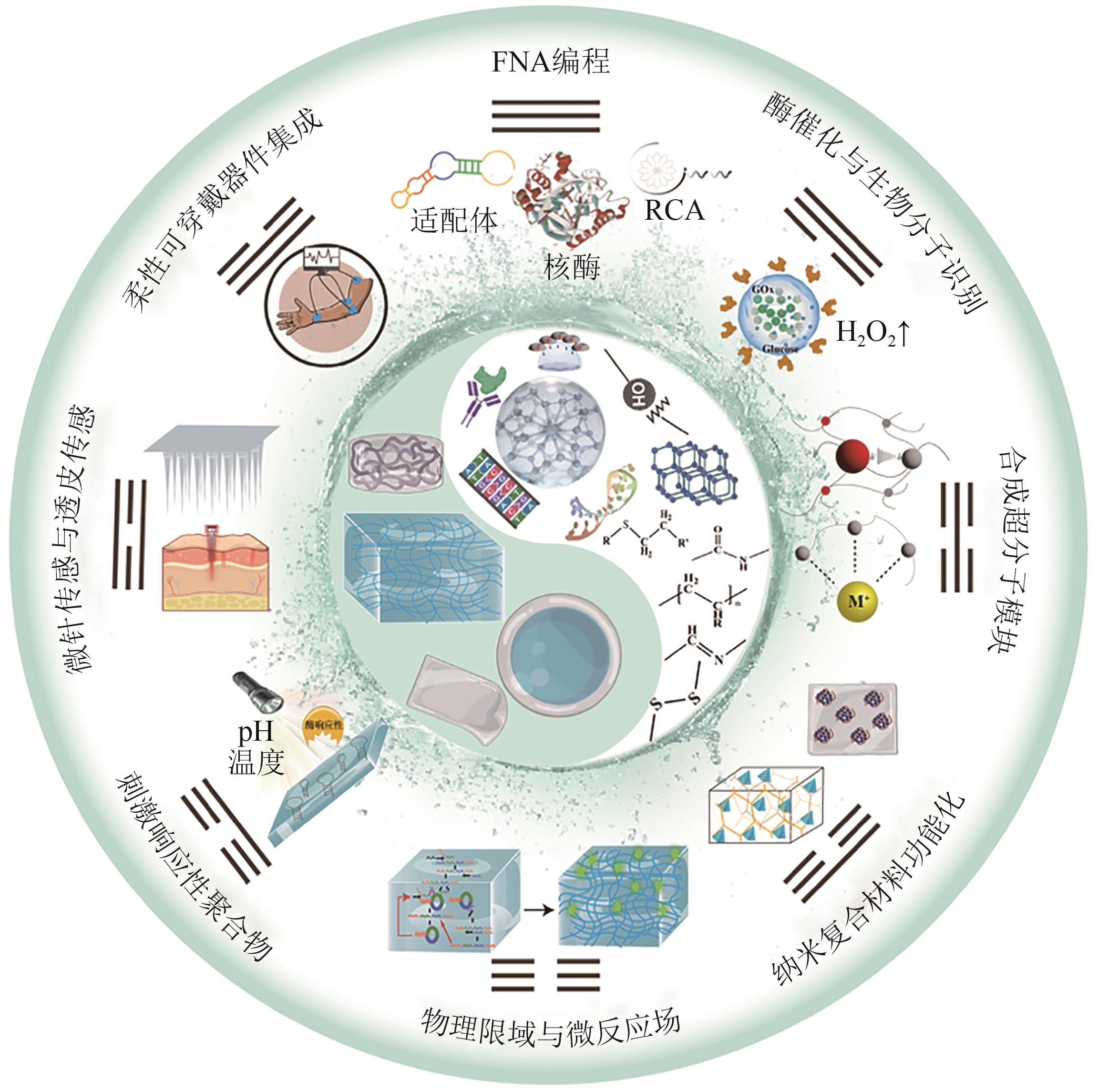
图1 水凝胶传感平台理性设计框架示意图
Fig. 1 Schematic diagram of the rational design framework for hydrogel sensing platforms
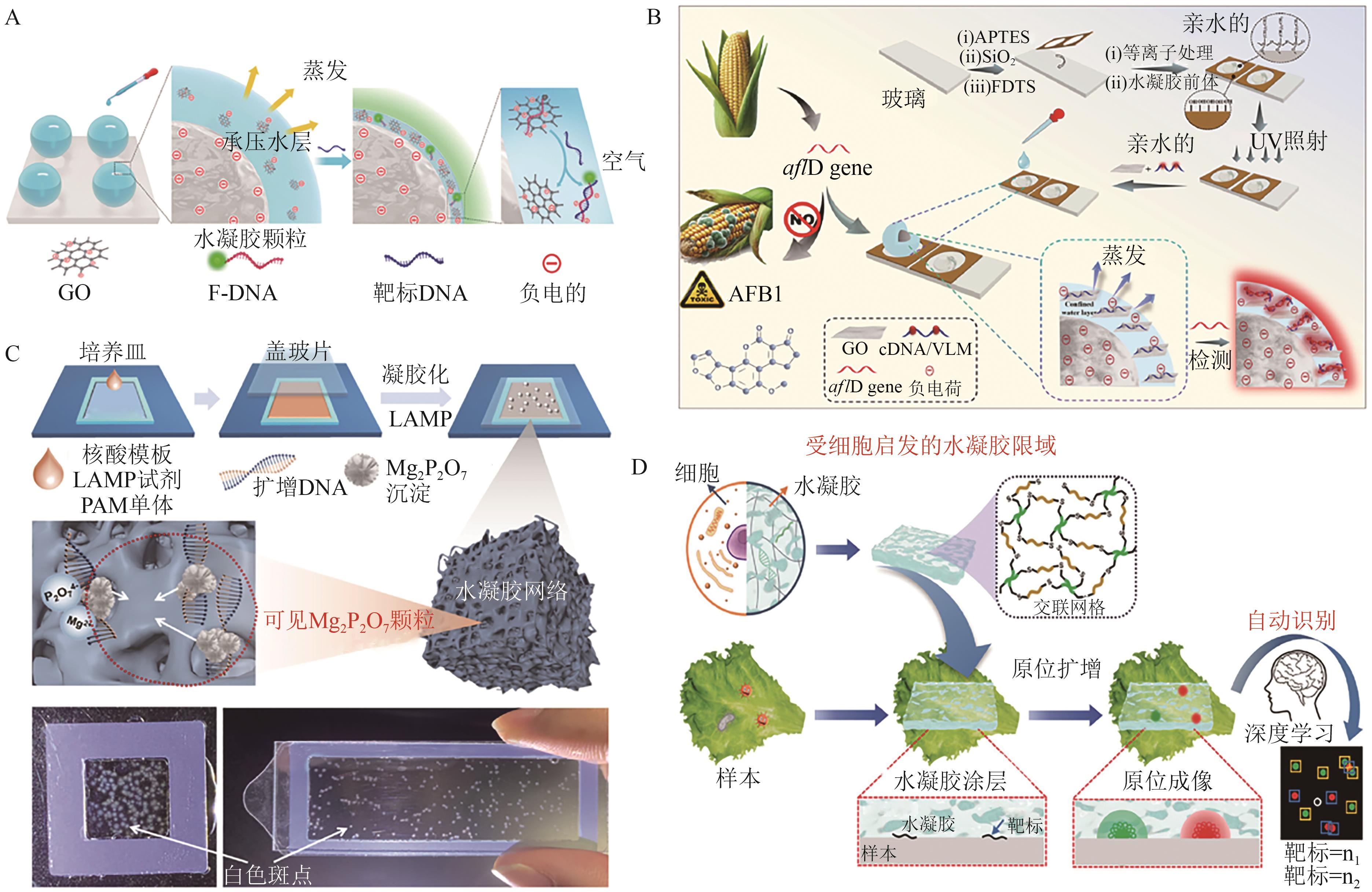
图2 基于物理限域与微反应场功能设计的水凝胶传感与成像策略A:空间限域水凝胶颗粒用于荧光DNA检测[62];B:水凝胶颗粒阵列用于黄曲霉毒素 B1(aflatoxin B1,AFB1)早期预警[63];C:聚丙烯酰胺(acrylamide,PAM)水凝胶中的纳米限域核酸扩增[68];D:水凝胶原位信号级联扩增(in-situ signal cascade amplification in hydrogels,iSCIA)技术用于生物样本表面核酸的原位成像[65]
Fig. 2 Hydrogel-based sensing and imaging strategies leveraging physical confinement and microreaction environment designs
| [1] | KIM J, CAMPBELL A S, DE ÁVILA B E, et al.. Wearable biosensors for healthcare monitoring[J]. Nat. Biotechnol., 2019, 37(4): 389-406. |
| [2] | CHANDRA P. Personalized biosensors for point-of-care diagnostics: from bench to bedside applications[J]. Nanotheranostics, 2023, 7(2): 210-215. |
| [3] | CLARK L C J, LYONS C. Electrode systems for continuous monitoring in cardiovascular surgery[J]. Ann. N. Y. Acad. Sci., 1962, 102: 29-45. |
| [4] | RENNEBERG R, PFEIFFER D, LISDAT F, et al.. Frieder scheller and the short history of biosensors[M]// Biosensing for the 21st Century. Berlin, Heidelberg: Springer, 2007: 1-18. |
| [5] | THÉVENOT D R, TOTH K, DURST R A, et al.. Electrochemical biosensors: recommended definitions and classification[J]. Anal. Lett., 2001, 34(5): 635-659. |
| [6] | LIEDBERG B, NYLANDER C, LUNSTRÖM I. Surface plasmon resonance for gas detection and biosensing[J]. Sens. Actuat., 1983, 4: 299-304. |
| [7] | SINGH A K, MITTAL S, DAS M, et al.. Optical biosensors: a decade in review[J]. Alex. Eng. J., 2023, 67: 673-691. |
| [8] | CHENANI H, SAEIDI M, RASTKHIZ M A, et al.. Challenges and advances of hydrogel-based wearable electrochemical biosensors for real-time monitoring of biofluids: from lab to market. a review[J]. Anal. Chem., 2024, 96(20): 8160-8183. |
| [9] | LI P, LEE G H, KIM S Y, et al.. From diagnosis to treatment: recent advances in patient-friendly biosensors and implantable devices[J]. ACS Nano, 2021, 15(2): 1960-2004. |
| [10] | BUWALDA S J, BOERE K W M, DIJKSTRA P J, et al.. Hydrogels in a historical perspective: from simple networks to smart materials[J]. J. Control. Release, 2014, 190: 254-273. |
| [11] | KOPECEK J. Hydrogel biomaterials: a smart future?[J]. Biomaterials, 2007, 28(34): 5185-5192. |
| [12] | SUN X, DING C, QIN M, et al.. Hydrogel-based biosensors for bacterial infections[J/OL]. Small, 2024, 20(11): 2306960[2025-12-01]. . |
| [13] | LIN X, YAN H, ZHAO L, et al.. Hydrogel-integrated sensors for food safety and quality monitoring: fabrication strategies and emerging applications[J]. Crit. Rev. Food Sci. Nutr., 2024, 64(18): 6395-6414. |
| [14] | CHO T, CHANG C C, CHAN H P, et al.. Hydrogels: properties and applications in biomedicine[J/OL]. Molecules, 2022, 27(9): 2902[2025-12-01]. . |
| [15] | HERRMANN A, HAAG R, SCHEDLER U. Hydrogels and their role in biosensing applications[J/OL]. Adv. Healthc. Mater., 2021, 10(11): 2100062[2025-12-01]. . |
| [16] | ZHANG Y, ZHU L, TIAN J, et al.. Smart and functionalized development of nucleic acid-based hydrogels: assembly strategies, recent advances, and challenges[J/OL]. Adv. Sci., 2021, 8(14): 2100216[2025-12-01].. |
| [17] | WANG H, WANG X, LAI K, et al.. Stimulus-responsive DNA hydrogel biosensors for food safety detection[J/OL]. Biosensors, 2023, 13(3): 320[2025-12-01]. . |
| [18] | MORYA V, WALIA S, MANDAL B B, et al.. Functional DNA based hydrogels: development, properties and biological applications[J]. ACS Biomater. Sci. Eng., 2020, 6(11): 6021-6035. |
| [19] | SU Y, ZHU L, WU Y, et al.. Progress and challenges in bacterial whole-cell-components aptamer advanced screening and site identification[J/OL]. Trac. Trends Anal. Chem., 2022, 157: 116731[2025-12-01]. . |
| [20] | ARAN G C, BAYRAÇ C. Simultaneous dual-sensing platform based on aptamer-functionalized DNA hydrogels for visual and fluorescence detection of chloramphenicol and aflatoxin M1[J]. Bioconjug. Chem., 2023, 34(5): 922-933. |
| [21] | PARK C H, THOMPSON I A P, NEWMAN S S, et al.. Real-time spatiotemporal measurement of extracellular signaling molecules using an aptamer switch-conjugated hydrogel matrix[J/OL]. Adv. Mater., 2024, 36(4): 2306704[2025-12-01]. . |
| [22] | ZHAO J, DONG J, XU R, et al.. Novel glove-type flexible aptasensor based on DNA hydrogel for the detection of organophosphorus pesticide residues in vegetables[J/OL]. Sens. Actuat. B Chem., 2026, 447: 138716[2025-12-01]. . |
| [23] | ZHANG M, HAN M, SU R, et al.. Ultra-small manganese dioxide nanozyme-packaged aptameric DNA hydrogel for highly sensitive xanthine detection through smartphone-assisted visualization[J/OL]. Biosens. Bioelectron., 2026, 294: 118212[2025-12-01]. . |
| [24] | ZHANG Y, MENG F, GU Z, et al.. A multiplexed assay by self-assembled dual-target responsive DNA hydrogels for efficacy evaluation of immunotherapy[J/OL]. Nat. Commun., 2025, 16(1):1836[2025-12-01]. . |
| [25] | WANG H, ZHAO Z, XU Y, et al.. Programming molecular switches within capacitive PEDOT: DNA hydrogels for deciphering pathophysiological microenvironment dynamics in diabetic wound[J]. Nano Lett., 2025, 25(51): 17778-17789. |
| [26] | CHU J, CHEN C, LI X, et al.. A responsive pure DNA hydrogel for label-free detection of lead ion[J/OL]. Anal. Chim. Acta, 2021, 1157: 338400[2025-12-01]. . |
| [27] | JIANG C, LI Y, WANG H, et al.. A portable visual capillary sensor based on functional DNA crosslinked hydrogel for point-of-care detection of lead ion[J/OL]. Sens. Actuat. B Chem., 2020, 307: 127625[2025-12-01]. . |
| [28] | MANN H, KHAN S, PRASAD A, et al.. Bacteriophage-activated DNAzyme hydrogels combined with machine learning enable point-of-use colorimetric detection of Escherichia coli [J/OL]. Adv. Mater., 2025, 37(3): 2411173[2025-12-01].. |
| [29] | LIU S, YANG Y, SHI M, et al.. Smartphone-based pure DNAzyme hydrogel platform for visible and portable colorimetric detection of cell-free DNA[J]. ACS Sens., 2022, 7(2): 658-665. |
| [30] | ZHAO X, MENG X, ZENG X, et al.. Homogeneous extraction-free dual-ctDNA detection via DNA nanomaterial fusion for rapid breast cancer diagnosis[J]. ACS Nano, 2025, 19(50): 42066-42078. |
| [31] | WANG W, SUN J, GAO Y, et al.. Ultra-sensitive detection of norovirus using a three-in-one CRISPR platform based on a DNA hydrogel and composite functional nanomaterials[J/OL]. J. Hazard. Mater., 2025, 482: 136523[2025-12-01].. |
| [32] | LI G, PANG W, BIAN Y, et al.. A surface-enhanced Raman scattering and colorimetric dual-mode aptasensor for ultrasensitive detection of kanamycin based on DNA hydrogel network fishing the MIL-101@AuNP nanohybrids[J/OL]. Sens. Actuat. B Chem., 2024, 414: 135937[2025-12-01]. . |
| [33] | SU D, ZHAO X, YAN X, et al.. Background-free sensing platform for on-site detection of carbamate pesticide through upconversion nanoparticles-based hydrogel suit[J/OL]. Biosens. Bioelectron., 2021, 194: 113598[2025-12-01].. |
| [34] | XU J, KHAN H, YANG L. Hydrogel paper-based analytical devices: separation-free in situ assay of small-molecule targets in whole blood[J]. Anal. Chem., 2021, 93(44): 14755-14763. |
| [35] | MARCHIANÒ V, PELLEGRINI C, TRICASE A, et al.. Mussel-bioinspired edible Ca2+-crosslinked alginate hydrogel electrodes for glucose gastrointestinal monitoring[J/OL]. Adv. Sci., 2026, 13(8): e16912[2025-12-01]. . |
| [36] | YANG W, HE H, LU T, et al.. Wet-chemical synthesis of AgCo@CQAS nanozyme: a novel high-activity copper-free laccase mimic for sensitive hydrogel-based pesticide detection[J/OL]. Biosens. Bioelectron., 2026, 295: 116892[2025-12-01].. |
| [37] | LI W, XU M, XIA Z, et al.. Phosphatase-like Ce(4+)@UiO-66-NH(2) nanozyme-based dual-mode hydrogel nanosensor for visual detection of paraoxon[J/OL]. Food Chem., 2026, 500: 147536[2025-12-01]. . |
| [38] | GAO Y, CHEN Y, LI M, et al.. Gelatin-based photonic hydrogels for visual detection of pathogenic Pseudomonas aeruginosa [J/OL]. Sens. Actuat. B Chem., 2021, 329: 129137[2025-12-01]. . |
| [39] | YAN K, WAN Y, XU F, et al.. Ionic crosslinking of alginate/carboxymethyl chitosan fluorescent hydrogel for bacterial detection and sterilization[J/OL]. Carbohydr. Polym., 2023, 302: 120427[2025-12-01].. |
| [40] | LI H, HU Y, LIN Z, et al.. Carbon dots-based stimuli-responsive hydrogel for in-situ detection of thiram on fruits and vegetables[J/OL]. Food Chem., 2024, 460(Pt 1): 140405[2025-12-01]. . |
| [41] | WU S, YANG Y, CHENG Y, et al.. Fluorogenic detection of mercury ion in aqueous environment using hydrogel-based AIE sensing films[J/OL]. Aggregate, 2023, 4(3): e287[2025-12-01]. . |
| [42] | NIAZY B, GHASEMZADEH H, KESHTKAR VANASHI A, et al.. Polyvinyl alcohol/polyacrylamide hydrogel-based sensor for lead (Ⅱ) ion sensing by resonance rayleigh scattering[J/OL]. React. Funct. Polym., 2022, 175: 105266[2025-12-01]. . |
| [43] | YANG X, WANG P, YANG H, et al.. A portable and selective fluorescent probe based on sodium alginate for simultaneous detection and adsorption of Fe(3)[J/OL]. Int. J. Biol. Macromol., 2026, 339(Pt2): 150036[2025-12-01].. |
| [44] | ZHANG D, TIAN X, LI H, et al.. Novel fluorescent hydrogel for the adsorption and detection of Fe (Ⅲ)[J/OL]. Colloids Surf. A Physicochem. Eng. Aspects, 2021, 608: 125563[2025-12-01]. . |
| [45] | GUO H, ZHU C, YUAN Z, et al.. Facile hydrogels of AIEgens applied as reusable sensors for in situ and early warning of metallic corrosion[J]. ACS Appl. Mater. Interfaces, 2023, 15(6): 8530-8536. |
| [46] | SU Y, CHU H, TIAN J, et al.. Insight into the nanomaterials enhancement mechanism of nucleic acid amplification reactions[J/OL]. Trac Trends Anal. Chem., 2021, 137: 116221[2025-12-01]. . |
| [47] | ZHAN Y, ZENG Y, LI L, et al.. Ratiometric fluorescent hydrogel test kit for on-spot visual detection of nitrite[J]. ACS Sens., 2019, 4(5): 1252-1260. |
| [48] | JIA P, HE X, YANG J, et al.. Dual-emission MOF-based ratiometric platform and sensory hydrogel for visible detection of biogenic amines in food spoilage[J/OL]. Sens. Actuat. B Chem., 2023, 374: 132803[2025-12-01]. . |
| [49] | WANG W, CHEN Y, XIAO C, et al.. Flexible SERS wearable sensor based on nanocomposite hydrogel for detection of metabolites and pH in sweat[J/OL]. Chem. Eng. J., 2023, 474: 145953[2025-12-01]. . |
| [50] | WANG Q, SUN D, MA X, et al.. Surface enhanced Raman scattering active substrate based on hydrogel microspheres for pretreatment-free detection of glucose in biological samples[J/OL]. Talanta, 2023, 260: 124657[2025-12-01].. |
| [51] | ZHAO M L, ZENG W J, CHAI Y Q, et al.. An affinity-enhanced DNA intercalator with intense ECL embedded in DNA hydrogel for biosensing applications[J]. Anal. Chem., 2020, 92(16): 11044-11052. |
| [52] | ZHOU J, ZHAO X, HUANG G, et al.. Molecule-specific terahertz biosensors based on an aptamer hydrogel-functionalized metamaterial for sensitive assays in aqueous environments[J]. ACS Sens., 2021, 6(5): 1884-1890. |
| [53] | HE X, SUN N, JIA H, et al.. Antifouling electrochemical biosensor based on conductive hydrogel of DNA scaffold for ultrasensitive detection of ATP[J]. ACS Appl. Mater. Interfaces, 2022, 14(36): 40624-40632. |
| [54] | HU X B, QIN Y, FAN W T, et al.. A three-dimensional electrochemical biosensor integrated with hydrogel enables real-time monitoring of cells under their in vivo-like microenvironment[J]. Anal. Chem., 2021, 93(22): 7917-7924. |
| [55] | LU X, SI Y, ZHANG S, et al.. In situ synthesis of mechanically robust, transparent nanofiber-reinforced hydrogels for highly sensitive multiple sensing[J/OL]. Adv. Funct. Mater., 2021, 31(30): 2103117[2025-12-01]. . |
| [56] | WANG X, XU H, ZHANG C, et al.. A hot-humid tolerant and antibacterial MXene-based hydrogel sensor for real-time cardiorespiratory monitoring in endurance sports[J/OL]. Microsyst. Nanoeng., 2025, 11(1):148[2025-12-01]. . |
| [57] | HU C, LIANG A, DU S M, et al.. Janus metal-AIEgen Framework@Hydrogel patch for ultrasensitive, multivariate responsive, and intelligent point-of-care sensors[J]. Anal. Chem., 2026, 98(1): 860-873. |
| [58] | SHAO J, GU J, MO H, et al.. Apt-nanogel-kit for real-time quantitative monitoring of the released H2O2 from living cells and point-of-care application[J]. Anal. Chem., 2026, 98(1): 1078-1089. |
| [59] | LI S, DAI J, ZHU M, et al.. Implantable hydrogel-protective DNA aptamer-based sensor supports accurate, continuous electrochemical analysis of drugs at multiple sites in living rats[J]. ACS Nano, 2023, 17(18): 18525-18538. |
| [60] | ANSAH I B, KIM S, YANG J Y, et al.. In situ electrodeposition of gold nanostructures in 3D ultra-thin hydrogel skins for direct molecular detection in complex mixtures with high sensitivity[J/OL]. Laser Photonics Rev., 2021, 15(12): 2170060[2025-12-01]. . |
| [61] | XU C Y, MI J, ZHAO J F, et al.. Magnetic hydrogel: enhanced bacterial biosensor for speedy gut disease detection[J]. ACS Sens., 2025, 10(11): 8424-8434. |
| [62] | LIU F, YANG Y, WAN X, et al.. Space-confinment-enhanced fluorescence detection of DNA on hydrogel particles array[J]. ACS Nano, 2022, 16(4): 6266-6273. |
| [63] | ETTAYRI K, ZHANG H, TIAN W, et al.. Space-confined hydrogel particle-based biosensor for early warning of aflatoxin B1 via rapid label-free fluorescence detection of the aflD gene[J]. Anal. Chem., 2025, 97(47): 26024-26033. |
| [64] | YI C, LUO Z, LU Y, et al.. Nanoporous hydrogel for direct digital nucleic acid amplification in untreated complex matrices for single bacteria counting[J/OL]. Biosens. Bioelectron., 2021, 184: 113199[2025-12-01]. . |
| [65] | YANG T, LI D, LUO Z, et al.. Space-confined amplification for in situ imaging of single nucleic acid and single pathogen on biological samples[J/OL]. Adv. Sci., 2024, 11(44): 2407055[2025-12-01]. . |
| [66] | YANG T, LI D, YAN Y, et al.. Ultrafast and absolute quantification of SARS-CoV-2 on food using hydrogel RT-LAMP without pre-lysis[J/OL]. J. Hazard. Mater., 2023, 442: 130050[2025-12-01]. . |
| [67] | YANG T, LUO Z, WANG Y, et al.. Hydrogel digital LAMP with suppressed nonspecific amplification for rapid diagnostics of fungal disease in fresh fruits[J]. J. Agric. Food Chem., 2023, 71(47): 18636-18644. |
| [68] | FANG M, WANG Y, YANG T, et al.. Nucleic acid plate culture: label-free and naked-eye-based digital loop-mediated isothermal amplification in hydrogel with machine learning[J]. ACS Sens., 2024, 9(4): 2010-2019. |
| [69] | CHEN F, XUE J, BAI M, et al.. Lighting up nucleic acid modifications in single cells with DNA-encoded amplification[J]. Acc. Chem. Res., 2022, 55(16): 2248-2259. |
| [70] | SCARPA E, MASTRONARDI V M, GUIDO F, et al.. Wearable piezoelectric mass sensor based on pH sensitive hydrogels for sweat pH monitoring[J/OL]. Sci. Rep., 2020, 10(1):11266[2025-12-01]. . |
| [71] | ALASALVAR H, KARABULUT G, GOKSEN G. Natural deep eutectic solvent-based pectin-chitosan composite hydrogel films: a novel pH-responsive color indicator for food packaging systems[J/OL]. Curr. Res. Food Sci., 2025, 11: 101241[2025-12-01]. . |
| [72] | ZHAO F, MA G, ZHANG Y, et al.. A universal protein immobilization method to construct responsive photonic hydrogels with enhanced sensing performance[J/OL]. J. Colloid Interface Sci., 2026, 706: 139747[2025-12-01].. |
| [73] | KEYVANI F, ZHENG H, KAYSIR M R, et al.. A hydrogel microneedle assay combined with nucleic acid probes for on-site detection of small molecules and proteins[J/OL]. Angew. Chem. Int. Ed., 2023, 62(21): e202301624[2025-12-01].. |
| [74] | ZHENG H, GHAVAMINEJAD A, GHAVAMINEJAD P, et al.. Hydrogel microneedle-assisted assay integrating aptamer probes and fluorescence detection for reagentless biomarker quantification[J]. ACS Sens., 2022, 7(8): 2387-2399. |
| [75] | SHARIFUZZAMAN M, HASABNIS G, AABU SALEH S, et al.. Hydrogel microneedle array-based transdermal dressing system for multiplexed assessment and intelligent therapy of chronic wounds[J/OL]. Small, 2026, 22(10): e11542[2025-12-01].. |
| [76] | ARWANI R T, TAN S C L, SUNDARAPANDI A, et al.. Stretchable ionic-electronic bilayer hydrogel electronics enable in situ detection of solid-state epidermal biomarkers[J]. Nat. Mater., 2024, 23(8): 1115-1122. |
| [77] | GAO X, YAN C, WANG Y, et al.. Multi-functional zwitterionic glycerylphosphorylcholine hydrogel for human motion detection and human-machine interaction[J/OL]. J. Colloid Interface Sci., 2026, 706: 139588[2025-12-01].. |
| [1] | 岳庆春, 孟思远, 刘国华. 主要农作物种子转基因检测技术及筛查策略研究进展[J]. 生物技术进展, 2026, 16(1): 1-9. |
| [2] | 苏丽娜, 李凤新, 吴杰, 曾宪东, 郑剑. 食品香菇源性成分荧光PCR检测方法研究[J]. 生物技术进展, 2026, 16(1): 149-156. |
| [3] | 曹硕, 张正昆, 李琛琛. 即时检测技术用于病原体检测的研究进展[J]. 生物技术进展, 2026, 16(1): 53-60. |
| [4] | 田锦, 高芳瑞, 李玲, 陈子言, 陈一帆, 张华, 陈红, 王颢潜, 梁晋刚. 转基因玉米Bt11特异性定性PCR检测方法的建立[J]. 生物技术进展, 2025, 15(6): 1031-1039. |
| [5] | 李柔柔, 赵璞, 郑亚妮, 杨婧宇, 马春红, 王星, 周硕. 玉米黄素的研究进展与展望[J]. 生物技术进展, 2025, 15(5): 755-763. |
| [6] | 杨倩, 宋志灵. 溶瘤病毒在生物传感器中的研究进展[J]. 生物技术进展, 2025, 15(5): 798-803. |
| [7] | 刘莹莹, 李若薇, 王艺霏. 核酸检测试剂冻干技术及其评价方法研究进展[J]. 生物技术进展, 2025, 15(5): 804-811. |
| [8] | 李明, 曲楠楠, 李伟. 抗体药物连续生物工艺的技术突破与监管挑战[J]. 生物技术进展, 2025, 15(5): 845-853. |
| [9] | 施玥, 韩尧, 李浩, 孙岩松. 场效应晶体管生物传感器在核酸检测中的应用进展[J]. 生物技术进展, 2025, 15(4): 597-605. |
| [10] | 贾艳艳, 端木路阳. 关于数字PCR扩增过程中气泡产生机理及抑制方法研究[J]. 生物技术进展, 2025, 15(4): 693-701. |
| [11] | 张月秋, 傅芳奇, 赵桐桐, 陈子言, 裴欣瑶, 高芳瑞, 李佳岢, 李辉, 江晓丹, 王颢潜, 陈红. 转基因耐除草剂大豆LP012-1转化体普通PCR定性检测方法的研究[J]. 生物技术进展, 2025, 15(3): 466-475. |
| [12] | 王智, 胡广, 付伟, 彭萱子, 张永江, 翟俊峰. 基于文献计量的转基因植物及其产品核酸检测技术发展态势分析[J]. 生物技术进展, 2025, 15(3): 476-485. |
| [13] | 王梓乐, 陈冬东, 彭涛. 基于Web of Science数据库的真菌毒素检测技术可视化计量分析[J]. 生物技术进展, 2025, 15(2): 314-324. |
| [14] | 齐鑫, 李欣然, 郭亚宁, 王丹, 李凯, 吴琼, 李亮. 基于数字PCR方法的玉米内标准基因比较研究[J]. 生物技术进展, 2025, 15(1): 78-85. |
| [15] | 王晶, 关海涛, 张晓磊, 王堡槐, 刘宝海, 温洪涛. 农业基因编辑产品检测动态及发展趋势[J]. 生物技术进展, 2024, 14(5): 712-723. |
| 阅读次数 | ||||||
|
全文 |
|
|||||
|
摘要 |
|
|||||
