

生物技术进展 ›› 2026, Vol. 16 ›› Issue (1): 86-93.DOI: 10.19586/j.2095-2341.2025.0140
张东1( ), 张晓艳1, 李佳乐1, 张愿欣1, 张凤兰1, 杨忠仁1, 刘建文2, 旭花2()
收稿日期:2025-10-17
接受日期:2025-12-16
出版日期:2026-01-25
发布日期:2026-02-12
通讯作者:
旭花
作者简介:张东 E-mail: 1141764565@qq.com;
基金资助:
Dong ZHANG1(), Xiaoyan ZHANG1, Jiale LI1, Yuanxin ZHANG1, Fenglan ZHANG1, Zhongren YANG1, Jianwen LIU2, Hua XU2()
Received:2025-10-17
Accepted:2025-12-16
Online:2026-01-25
Published:2026-02-12
Contact:
Hua XU
摘要:
探究了干旱胁迫对药用植物乌拉尔甘草(Glycyrrhiza uralensis)幼苗生理特性的影响及抗旱适应机制。以一年生乌拉尔甘草苗为材料,采用盆栽控水模拟干旱胁迫,设置正常供水对照组(CK)、轻度干旱胁迫组(light stress,LS)、中度干旱胁迫组(moderate stress,MS)和重度干旱胁迫组(severe stress,SS),测定抗氧化系统及渗透调节物质等关键生理参数。结果发现,随着干旱胁迫程度的加剧,甘草叶和根中丙二醛(malondialdehyde,MDA)和H2O2含量整体呈增加趋势,而在MS组和SS组甘草根中
中图分类号:
张东, 张晓艳, 李佳乐, 张愿欣, 张凤兰, 杨忠仁, 刘建文, 旭花. 干旱胁迫对乌拉尔甘草苗生理特性的影响[J]. 生物技术进展, 2026, 16(1): 86-93.
Dong ZHANG, Xiaoyan ZHANG, Jiale LI, Yuanxin ZHANG, Fenglan ZHANG, Zhongren YANG, Jianwen LIU, Hua XU. Effects of Drought Stress on Physiological Characteristics of Licorice Seedlings[J]. Current Biotechnology, 2026, 16(1): 86-93.
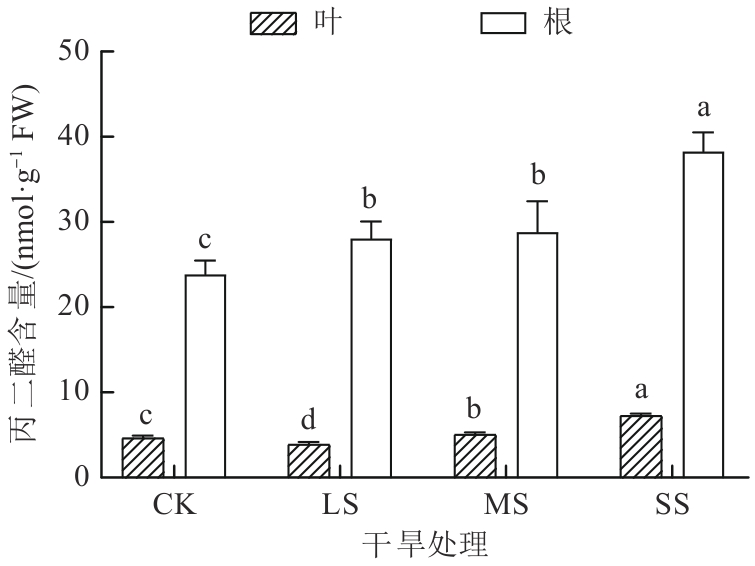
图1 干旱胁迫下甘草叶和根中丙二醛含量的变化注: 同一部位不同处理的不同小写字母表示差异在P<0.05水平有统计学意义。
Fig. 1 The MDA content in the leaves and roots of licorice under drought stress
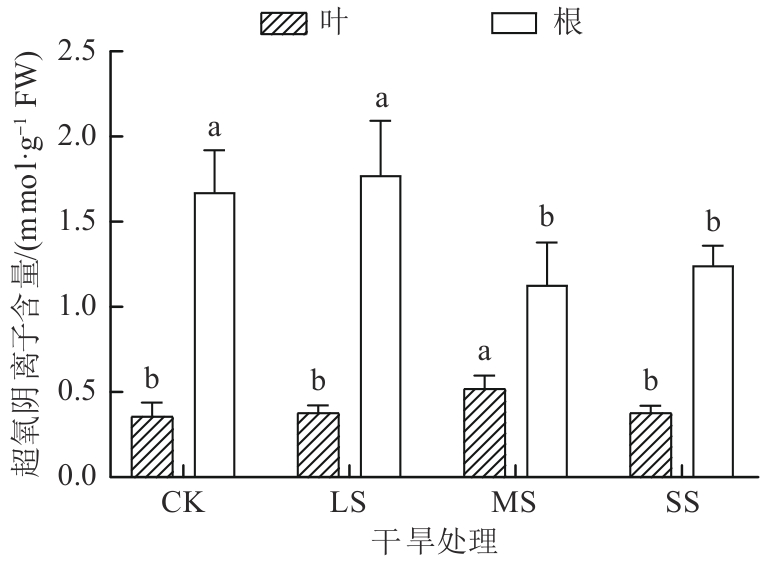
图2 干旱胁迫下甘草叶和根超氧阴离子含量的变化注: 同一部位不同处理的不同小写字母表示差异在P<0.05水平有统计学意义。
Fig. 2 The O2- content in the leaves and roots of licorice under drought stress
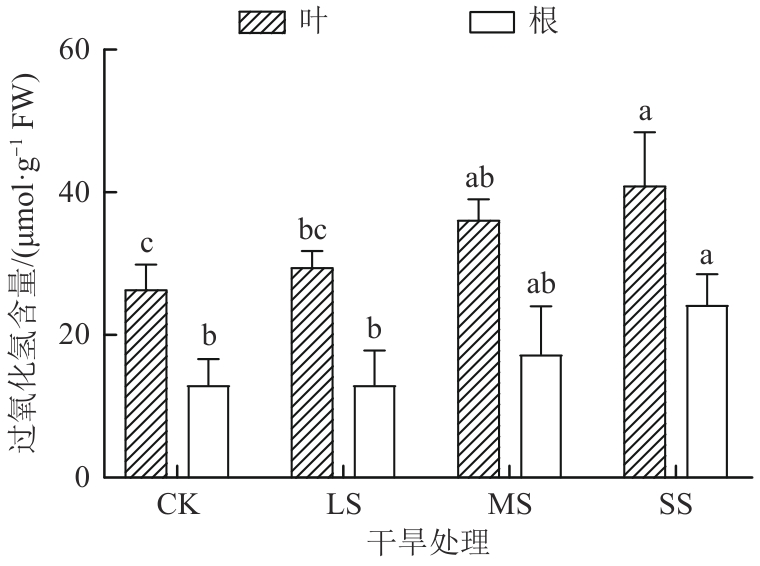
图3 干旱胁迫下甘草叶和根过氧化氢含量的变化注: 同一部位不同处理的不同小写字母表示差异在P<0.05水平有统计学意义。
Fig. 3 The H2O2 content in the leaves and roots of licorice under drought stress
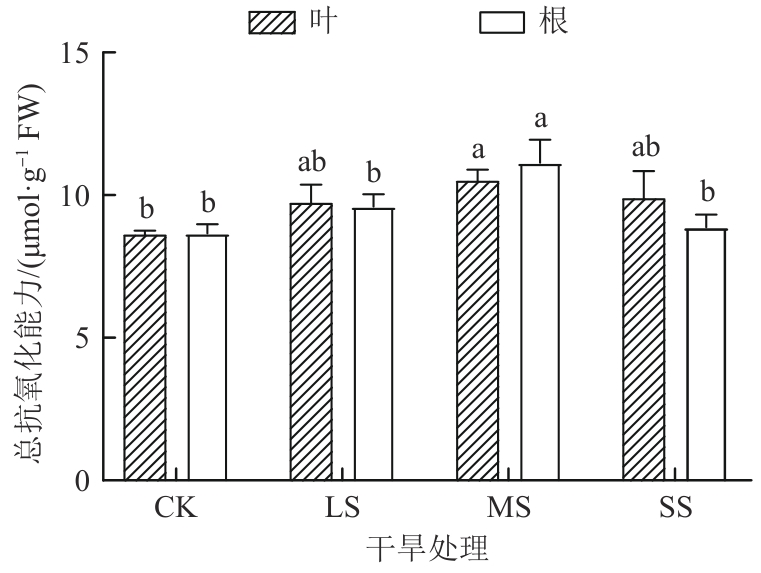
图4 干旱胁迫下甘草叶和根总抗氧化能力的变化注: 同一部位不同处理的不同小写字母表示差异在P<0.05水平有统计学意义。
Fig. 4 The T-AOC in the leaves and roots of licorice under drought stress
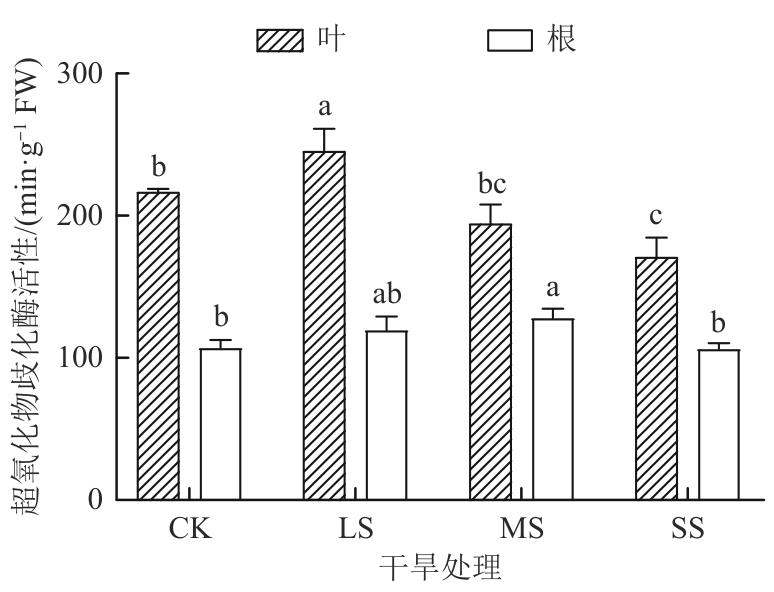
图5 干旱胁迫下甘草叶和根SOD活性的变化注: 同一部位不同处理的不同小写字母表示差异在P<0.05水平有统计学意义。
Fig. 5 The SOD activity in the leaves and roots of licorice under drought stress
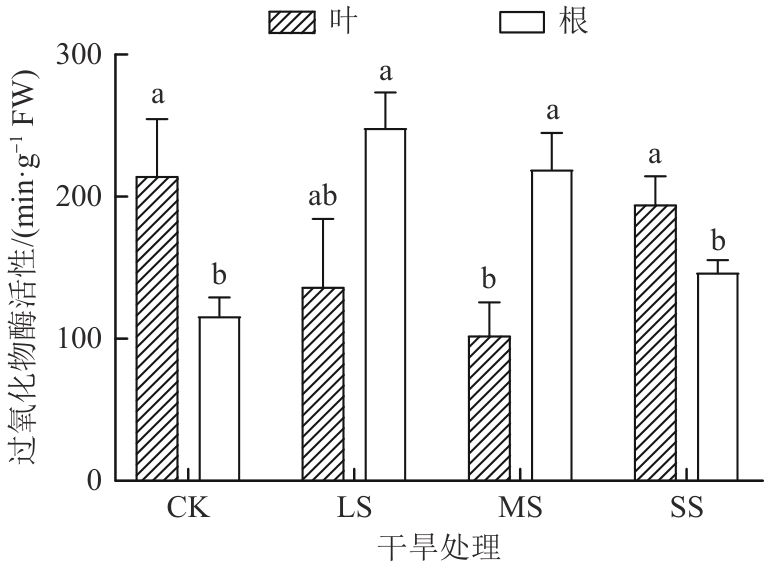
图6 干旱胁迫下甘草叶和根POD活性的变化注: 同一部位不同处理的不同小写字母表示差异在P<0.05水平有统计学意义。
Fig. 6 The POD activity in the leaves and roots of licorice under drought stress
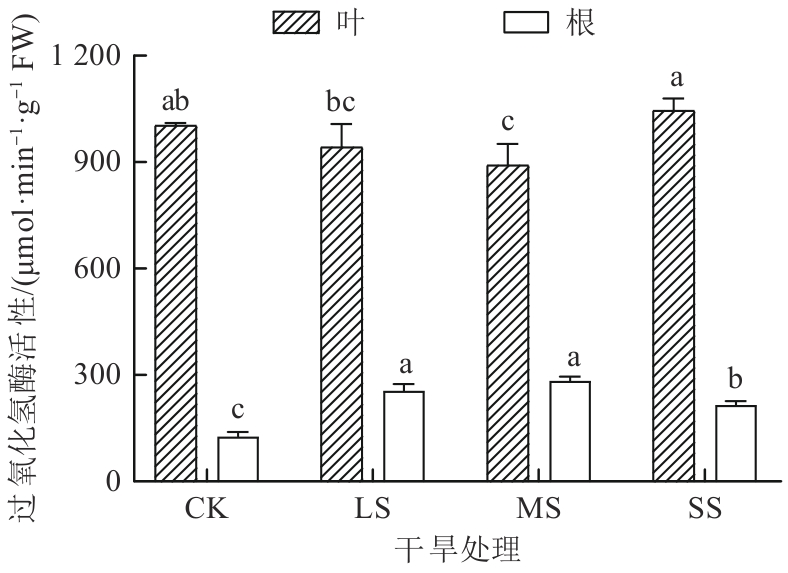
图7 干旱胁迫下甘草叶和根CAT活性的变化注: 同一部位不同处理的不同小写字母表示差异在P<0.05水平有统计学意义。
Fig. 7 The CAT activity of in the leaves and roots of licorice under drought stress
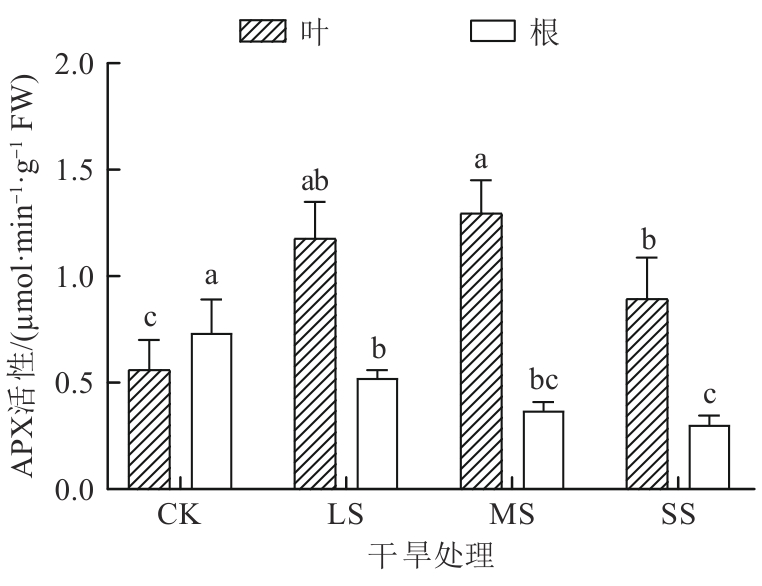
图8 干旱胁迫下甘草叶与根APX活性的变化注: 同一部位不同处理的不同小写字母表示差异在P<0.05水平有统计学意义。
Fig. 8 The APX activity in the leaves and roots of licorice under drought stress
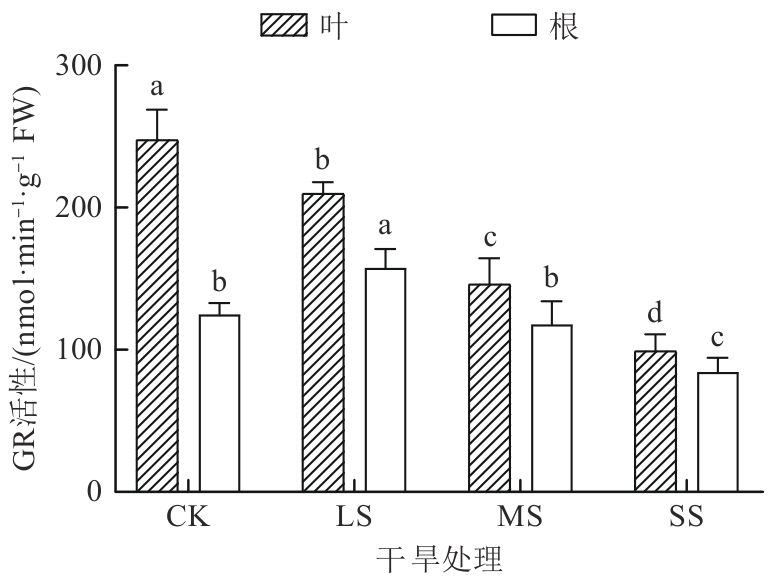
图9 干旱胁迫下甘草叶与根GR活性的变化注: 同一部位不同处理的不同小写字母表示差异在P<0.05水平有统计学意义。
Fig. 9 The GR activity in the leaves and roots of licorice under drought stress
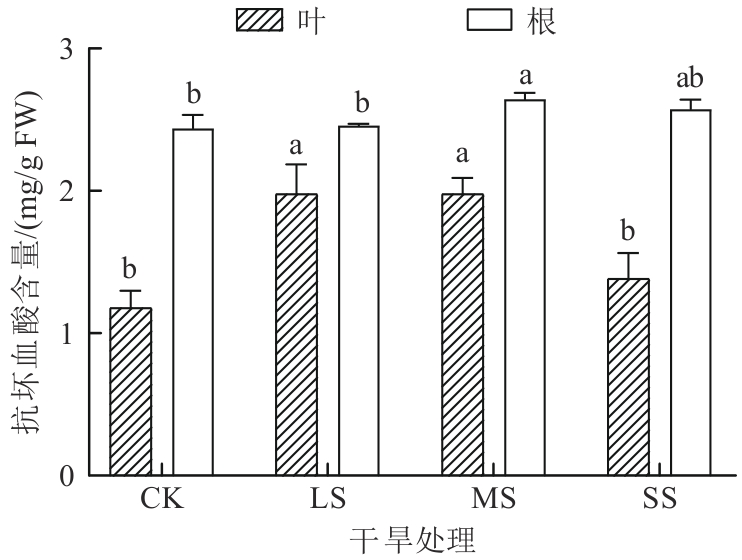
图10 干旱胁迫下甘草叶与根AsA含量的变化注: 同一部位不同处理的不同小写字母表示差异在P<0.05水平有统计学意义。
Fig. 10 The AsA content in the leaves and roots of licorice under drought stress
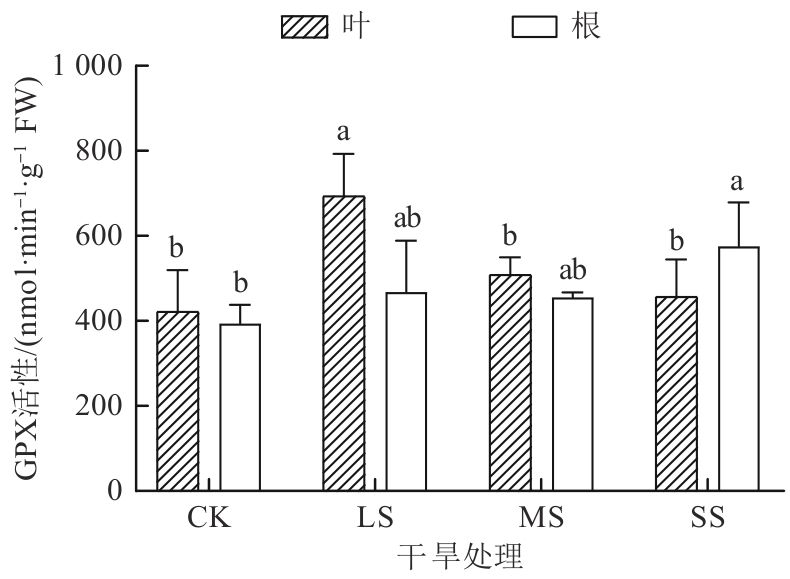
图11 干旱胁迫下甘草叶与根GPX活性的变化注: 同一部位不同处理的不同小写字母表示差异在P<0.05水平有统计学意义。
Fig. 11 The GPX activity in the leaves and roots of licorice under drought stress
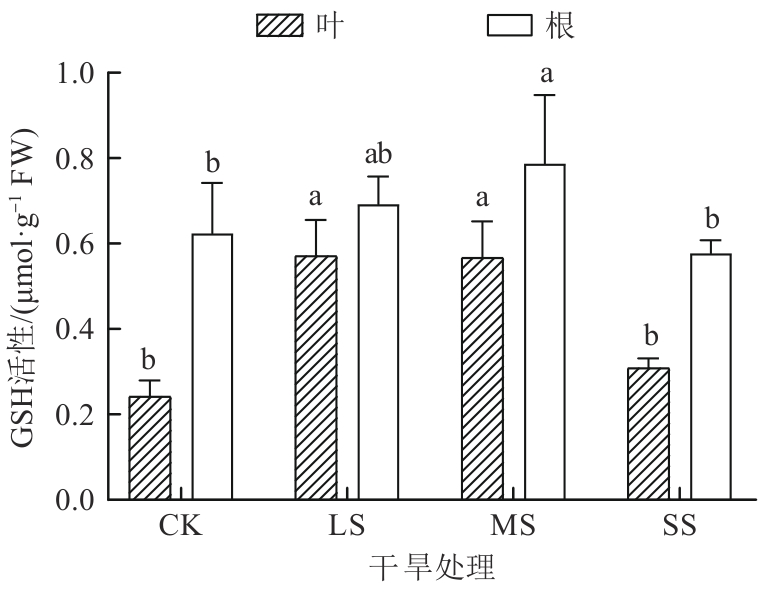
图12 干旱胁迫下甘草叶与根GSH活性的变化注: 同一部位不同处理的不同小写字母表示差异在P<0.05水平有统计学意义。
Fig. 12 The GSH activity in the leaves and roots of licorice under drought stress
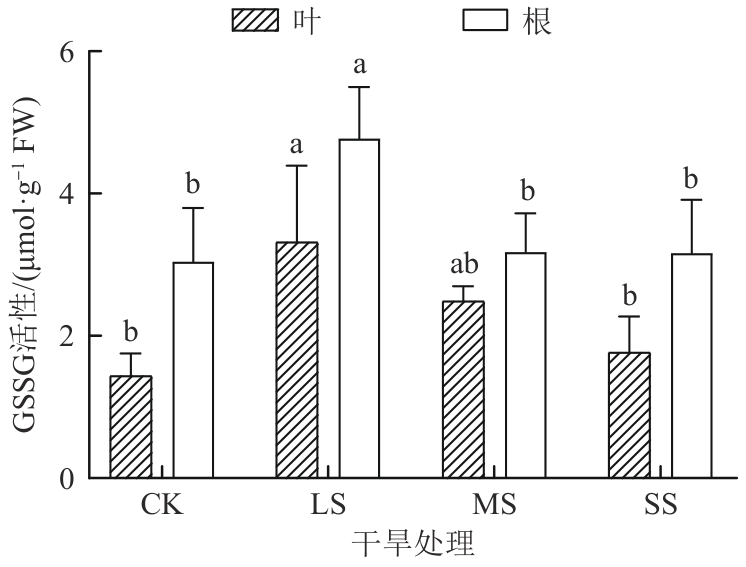
图13 干旱胁迫下甘草叶与根GSSG活性的变化注: 同一部位不同处理的不同小写字母表示差异在P<0.05水平有统计学意义。
Fig. 13 The GSSG activity in the leaves and roots of licorice under drought stress
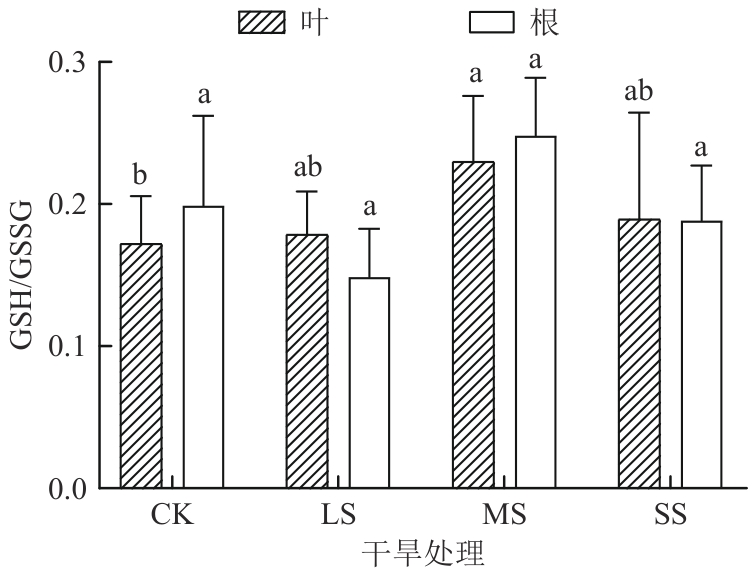
图14 干旱胁迫下甘草叶与根GSH/GSSG比值的变化注: 同一部位不同处理的不同小写字母表示差异在P<0.05水平有统计学意义。
Fig. 14 The GSH/GSSG value in the leaves and roots of licorice under drought stress
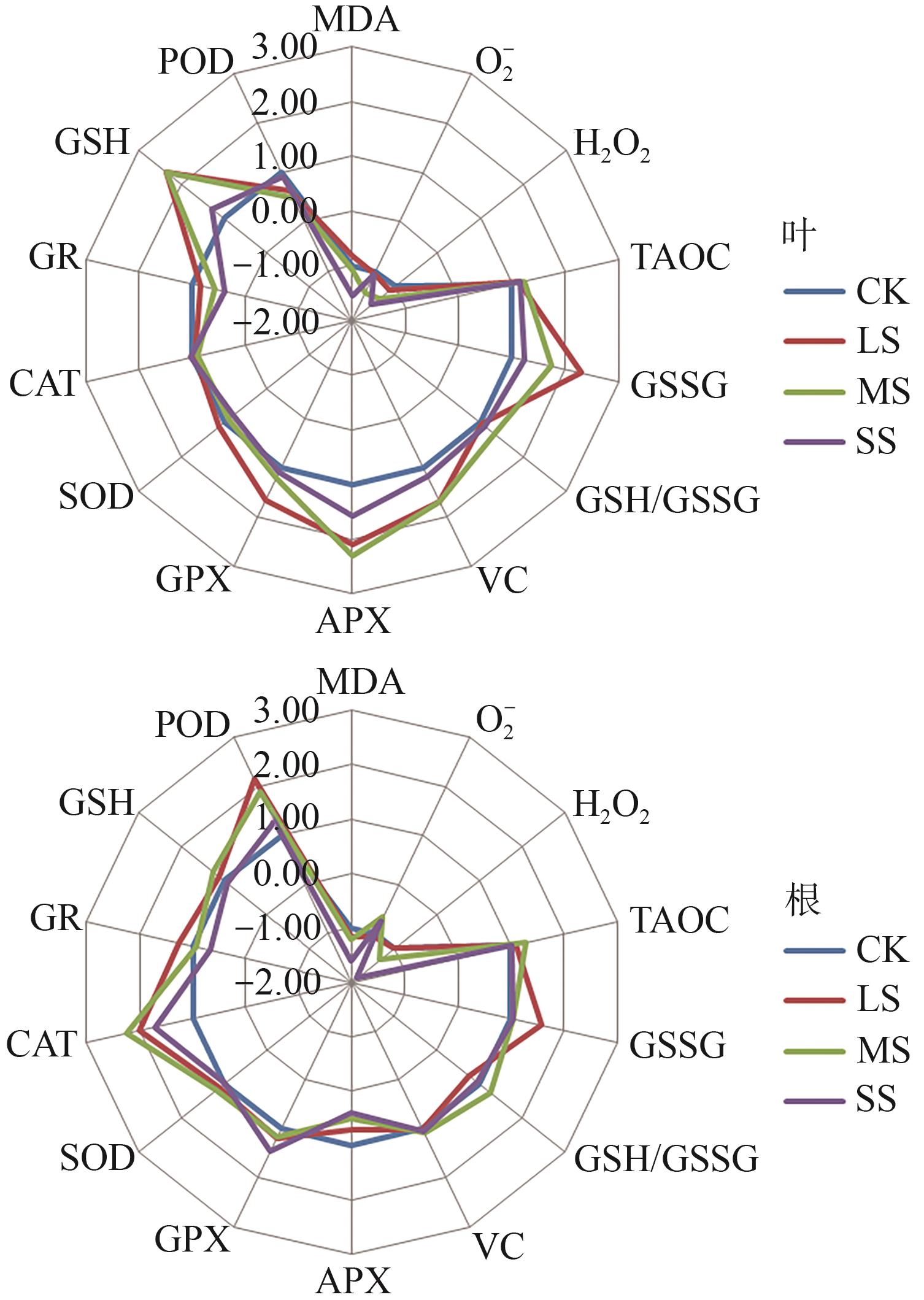
图15 甘草生理指标抗旱系数
Fig. 15 Drought resistance coefficient of licorice physiological indexes
| 处理 | 叶 | 根 | |||
|---|---|---|---|---|---|
| 总值 | 平均值 | 总值 | 平均值 | ||
| CK | 8.00 | 0.57 | 8.00 | 0.57 | |
| LS | 12.80 | 0.91 | 10.75 | 0.77 | |
| MS | 10.76 | 0.77 | 10.64 | 0.76 | |
| SS | 7.57 | 0.54 | 7.28 | 0.52 | |
表1 甘草叶和甘草根各处理的综合抗旱系数
Table 1 Comprehensive drought resistance coefficients on all indicators of licorice
| 处理 | 叶 | 根 | |||
|---|---|---|---|---|---|
| 总值 | 平均值 | 总值 | 平均值 | ||
| CK | 8.00 | 0.57 | 8.00 | 0.57 | |
| LS | 12.80 | 0.91 | 10.75 | 0.77 | |
| MS | 10.76 | 0.77 | 10.64 | 0.76 | |
| SS | 7.57 | 0.54 | 7.28 | 0.52 | |
| [1] | 杨京京,宁克伟,王明娟,等.陆地棉萌发期抗旱性评价方法及石河子垦区优质种质资源筛选[J].生物技术进展,2025,15(3):486-494. |
| YANG J J, NING K W, WANG M J, et al.. The evaluation method for drought resistance during the germination period of upland cotton and screening of high-quality germplasm resources in the Shihezi reclamation area[J]. Curr. Biotechnol., 2025, 15(3): 486-494. | |
| [2] | OBATA T, FERNIE A R. The use of metabolomics to dissect plant responses to abiotic stresses[J]. Cell. Mol. Life Sci., 2012, 69(19): 3225-3243. |
| [3] | 郝培彤,李玉龙,宁亚明,等.不同干旱处理对科尔沁沙地不同苜蓿品种生产性能的影响[J].草地学报,2018(6):1368-1373. |
| HAO P T, LI Y L, NING Y M, et al.. Effects of different drought treatments on productive performance of different alfalfa varieties in Horqin Sandy Land[J]. Acta Agrestia Sin., 2018(6): 1368-1373. | |
| [4] | FAIZE M, BURGOS L, FAIZE L, et al.. Involvement of cytosolic ascorbate peroxidase and Cu/Zn-superoxide dismutase for improved tolerance against drought stress[J]. J. Exp. Bot., 2011, 62: 2599-2613. |
| [5] | BARTOLI C G, GÓMEZ F, MARTÍNEZ D E, et al.. Mitochondria are the main target for oxidative damage in leaves of wheat (Triticum aestivum L.)[J]. J. Exp. Bot., 2004, 55(403): 1663-1669. |
| [6] | FAROOQ A, BUKHARI S A, AKRAM N A, et al.. Exogenously applied ascorbic acid-mediated changes in osmoprotection and oxidative defense system enhanced water stress tolerance in different cultivars of safflower (Carthamus tinctorious L.)[J/OL]. Plants, 2020, 9(1): 104[2025-10-21]. . |
| [7] | LIU H, SULTAN M A R F, LIU X L, et al.. Physiological and comparative proteomic analysis reveals different drought responses in roots and leaves of drought-tolerant wild wheat (Triticum boeoticum)[J/OL]. PLoS One, 2015, 10(4): e0121852[2025-10-02]. . |
| [8] | HUANG X S, WANG W, ZHANG Q, et al.. A basic helix-loop-helix transcription factor, PtrbHLH, of Poncirus trifoliata confers cold tolerance and modulates peroxidase-mediated scavenging of hydrogen peroxide[J]. Plant Physiol., 2013, 162(2): 1178-1194. |
| [9] | XU Y, LU J H, ZHANG J D, et al.. Transcriptome revealed the molecular mechanism of Glycyrrhiza in flata root to maintain growth and development, absorb and distribute ions under salt stress[J/OL]. BMC Plant Biol., 2021, 21(1): 599[2025-10-21]. . |
| [10] | XIE W, HAO Z, ZHOU X, et al.. Arbuscular mycorrhiza facilitates the accumulation of glycyrrhizin and liquiritin in Glycyrrhiza uralensis under drought stress[J]. Mycorrhiza, 2018, 28(3): 285-300. |
| [11] | LU J, LIANG W, LI J, et al.. Integrated morphology analysis, metabolomic analysis and gene expression to assess the quality of four adventitious roots lines of Glycyrrhiza uralensis Fisch[J]. Plant Cell Tissue Organ Cult., 2018, 135(1): 169-177. |
| [12] | 张东,刘艳,张晗,等.甘草叶片形态结构和光合作用对干旱胁迫的响应[J].植物研究,2021,41(3):449-457. |
| ZHANG D, LIU Y, ZHANG H, et al.. Response of photosynthesis and leaf morphological characteristics to drought stress in Glycyrrhiza uralensis [J]. Bull. Bot. Res., 2021, 41(3): 449-457. | |
| [13] | 陈娇,谢小玉,张小短,等.甘蓝型油菜苗期抗旱性鉴定及综合抗旱指标筛选[J].中国油料作物学报,2019,41(5):713-722. |
| CHEN J, XIE X Y, ZHANG X D, et al.. Seedling drought resistance and parameter screening of rapeseed[J]. Chin. J. Oil Crop Sci., 2019, 41(5): 713-722. | |
| [14] | RAMACHANDRA REDDY A, CHAITANYA K V, VIVEKANANDAN M. Drought-induced responses of photosynthesis and antioxidant metabolism in higher plants[J]. J. Plant Physiol., 2004, 161(11): 1189-1202. |
| [15] | GOLSHAN M, HABIBI D, BELADI S M, et al.. Copper and lead tolerance strategies in mustard (Sinapis arvensis) Egyptian clover (Trifolium alexandrinum) and hairy vetch (Vicia villosa): role of some antioxidant enzymes[J]. American-Eurasian J. Agri. Environ. Sci., 2011, 11: 122-128. |
| [16] | XING X H, FANG C W, LI L, et al.. Improved drought tolerance by α-naphthaleneacetic acid-induced ROS accumulation in two soybean cultivars[J]. J. Integr. Agric., 2016, 15(8): 1770-1784. |
| [17] | LIU J, LI J, SU X, et al.. Grafting improves drought tolerance by regulating antioxidant enzyme activities and stress-responsive gene expression in tobacco[J]. Environ. Exp. Bot., 2014, 107: 173-179. |
| [18] | 沈少炎,吴玉香,郑郁善.植物干旱胁迫响应机制研究进展:从表型到分子[J].生物技术进展,2017,7(3):169-176. |
| SHEN S Y, WU Y X, ZHENG Y S. Review on drought response in plants from phenotype to molecular[J]. Curr. Biotechnol., 2017, 7(3): 169-176. | |
| [19] | 卫星,王政权,张国珍,等.水曲柳苗木不同根序对干旱胁迫的生理生化反应[J].林业科学,2009,45(6):16-21. |
| WEI X, WANG Z Q, ZHANG G Z, et al.. Physiological and biochemical responses of different order roots in Fraxinus mandshurica seedlings to drought stress[J]. Sci. Silvae Sin., 2009, 45(6): 16-21. | |
| [20] | 刘济明,赵晓鹏,廖小峰,等.罗甸小米核桃抗氧化保护酶活性和丙二醛含量对干旱胁迫的响应[J].河南农业科学,2012,41(9):122-126. |
| LIU J M, ZHAO X P, LIAO X F, et al.. Study on protective enzyme system and MDA content of Juglans regia f. luodianense Liu et Xu under dry stress[J]. J. Henan Agric. Sci., 2012, 41(9): 122-126. | |
| [21] | SHARMA P, JHA A B, DUBEY R S, et al.. Reactive oxygen species, oxidative damage, and antioxidative defense mechanism in plants under stressful conditions[J/OL]. J. Bot., 2012, 2012: 217037[2025-10-21]. . |
| [22] | 张怡,路铁刚.植物中的活性氧研究概述[J].生物技术进展,2011,1(4):242-248. |
| ZHANG Y, LU T G. The research of reactive oxygen species(ROS) in plants[J]. Curr. Biotechnol., 2011, 1(4): 242-248. |
| [1] | 潘舟, 胡克. 线粒体功能障碍在缺氧性肺动脉高压中的作用[J]. 生物技术进展, 2023, 13(6): 882-888. |
| [2] | 李世明, 张鹏, 赵鹏翔, 谢飞, 陈晓萍, 刘梦昱. 氧化应激与废用性肌萎缩研究进展[J]. 生物技术进展, 2023, 13(4): 524-533. |
| [3] | 代地林, 吴园, 包明威. 单胺氧化酶A介导的活性氧簇在心血管疾病中的作用[J]. 生物技术进展, 2023, 13(4): 542-546. |
| [4] | 都润, 张思琦, 张海文, 陈涛. 逆境胁迫下向日葵的耐受机制[J]. 生物技术进展, 2022, 12(2): 205-212. |
| [5] | 钟丘实,李莉,陈新丹,张京,徐维娜,徐建雄. 2株乳杆菌全发酵培养物及其组分的抗氧化能力分析[J]. 生物技术进展, 2019, 9(3): 290-295. |
| [6] | 沈少炎,吴玉香,郑郁善,. 植物干旱胁迫响应机制研究进展——从表型到分子[J]. 生物技术进展, 2017, 7(3): 169-176. |
| [7] | 张靓,张兰,王晓萍. 转GmTMT2a基因玉米抗旱功能分析[J]. 生物技术进展, 2015, 5(2): 127-131. |
| [8] | 赵忠朝,张玉秀,周正富,张维,陈明. 耐辐射异常球菌抗氧化保护机制的研究进展[J]. 生物技术进展, 2013, 3(2): 109-114. |
| [9] | 张怡,路铁刚. 植物中的活性氧研究概述[J]. 生物技术进展, 2011, 1(4): 242-248. |
| [10] | 王春艳,庞艳梅,李茂松,王秀芬. 干旱胁迫对大豆苗期生长发育和生理生态特征的影响[J]. 生物技术进展, 2011, 1(4): 282-288. |
| 阅读次数 | ||||||
|
全文 |
|
|||||
|
摘要 |
|
|||||
