

生物技术进展 ›› 2026, Vol. 16 ›› Issue (3): 523-534.DOI: 10.19586/j.2095-2341.2026.0065
黎娟( ), 贺玉婷(), 冶晓轩(), 贾佳仪(), 张耀辉, 张宏扬(), 武陶()
收稿日期:2026-03-16
接受日期:2026-04-20
出版日期:2026-05-25
发布日期:2026-07-14
通讯作者:
张宏扬,武陶
作者简介:黎娟 E-mail: 3116588007@qq.com;基金资助:
Juan LI(), Yuting HE(), Xiaoxuan YE(), Jiayi JIA(), Yaohui ZHANG, Hongyang ZHANG(), Tao WU()
Received:2026-03-16
Accepted:2026-04-20
Online:2026-05-25
Published:2026-07-14
Contact:
Hongyang ZHANG,Tao WU
摘要:
类胡萝卜素是一类重要的天然萜类色素,在食品、医药、饲料和化妆品等领域具有广泛应用。微生物细胞工厂因具有生长快、遗传操作便捷和易于规模化培养等优势,已成为类胡萝卜素绿色高效生产的重要平台。系统综述了以大肠杆菌为代表的原核微生物以及以酿酒酵母和解脂耶氏酵母为代表的真核微生物在类胡萝卜素生物合成中的代谢工程改造策略,重点总结了前体供应途径优化、关键酶工程、代谢流重定向、辅因子调控、膜工程及多策略协同等方面的研究进展。在此基础上,进一步比较了原核与真核微生物在膜系统组成、疏水性产物储存能力及工程改造重点上的差异,分析了解脂耶氏酵母作为产油酵母在高疏水性类胡萝卜素合成中的独特优势及其定向驯化潜力,并对人工智能(artificial intelligence, AI)辅助代谢元件优化和相关未来研究方向进行了展望,以期为类胡萝卜素绿色高效生物制造和工业化应用提供参考。
中图分类号:
黎娟, 贺玉婷, 冶晓轩, 贾佳仪, 张耀辉, 张宏扬, 武陶. 微生物细胞工厂合成类胡萝卜素的代谢工程策略与应用进展[J]. 生物技术进展, 2026, 16(3): 523-534.
Juan LI, Yuting HE, Xiaoxuan YE, Jiayi JIA, Yaohui ZHANG, Hongyang ZHANG, Tao WU. Metabolic Engineering Strategies and Application Advances of Microbial Cell Factories for Carotenoid Production[J]. Current Biotechnology, 2026, 16(3): 523-534.
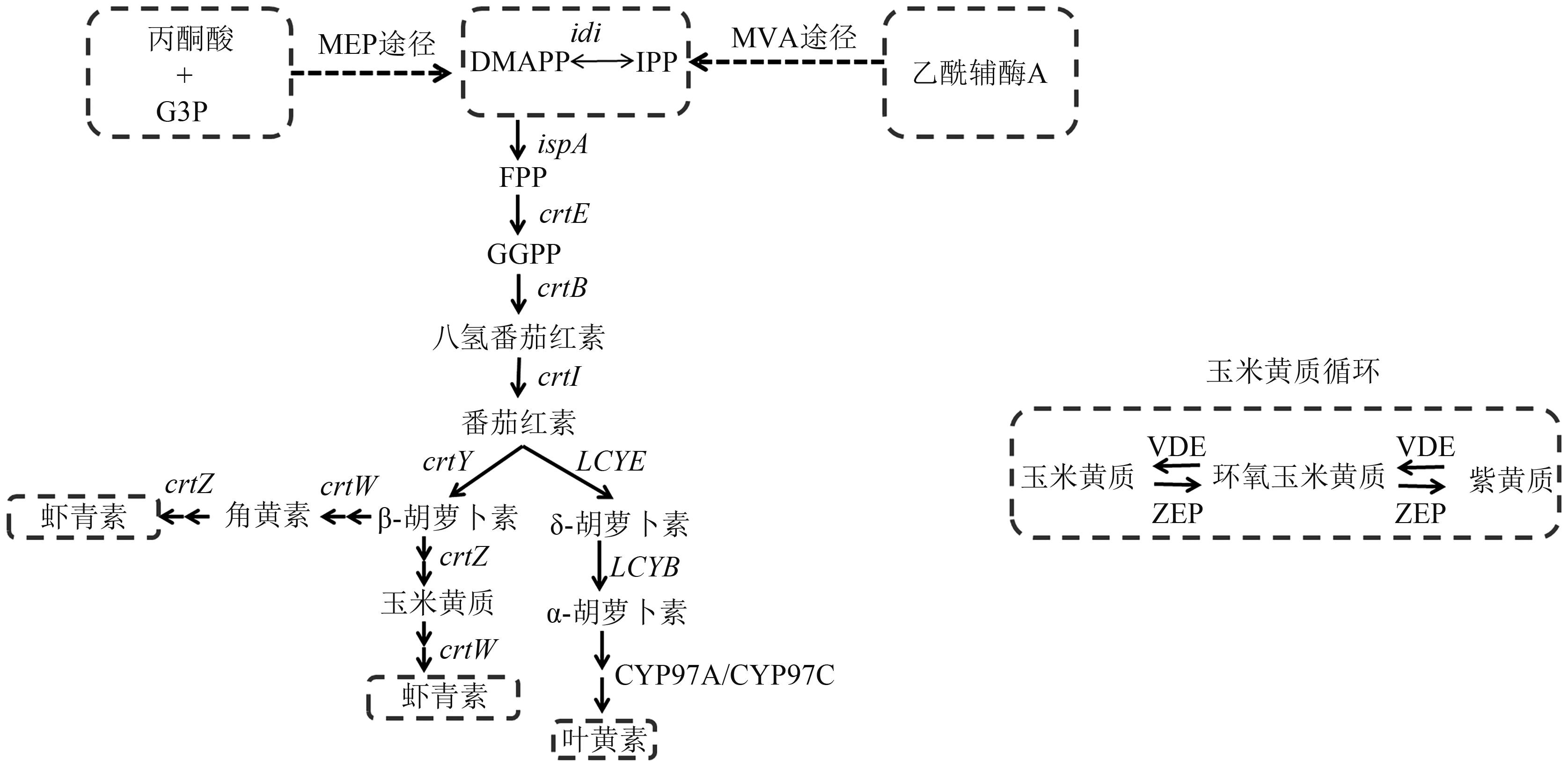
图1 类胡萝卜素合成途径注:G3P—甘油醛-3-磷酸(glyceraldehyde 3-phosphate);MEP—甲基赤藓糖醇磷酸(methyl erythritol phosphate);MVA—甲羟戊酸(mevalonic acid);FPP—法尼基焦磷酸(farnesyl diphosphate);GGPP—牻牛儿基牻牛儿焦磷酸(geranylgeranyl diphosphate);LCYE—番茄红素ε-环化酶(lycopene ε-cyclase);LCYB—番茄红素β-环化酶(lycopene β-cyclase);VDE—紫黄质脱环氧化酶(violaxanthin de-epoxidase);ZEP—玉米黄质环氧化酶(zeaxanthin epoxidase)。
Fig. 1 The carotenoid biosynthesis pathway
| 代表物种 | 代谢工程改造策略 | 核心产量 | 培养方式 | 参考文献 |
|---|---|---|---|---|
| 大肠杆菌 | 过表达MEP途径dxs+ispG基因,强化IPP/DMAPP前体合成 | IPP/DMAPP产量提升1.8倍,β-胡萝卜素从120 mg·L-1增至216 mg·L-1 | 摇瓶 | [ |
| 导入异源MVA途径 | β-胡萝卜素产量达465 mg·L-1,前体IPP供应提升2.3倍 | 发酵罐 | [ | |
| 改造MEP模块、β-胡萝卜素合成核心模块 | MEP模块的工程使β-胡萝卜素产量提高3.5倍,而β-胡萝卜素合成模块的工程则使产量提高3.4倍 | 补料分批发酵 | [ | |
| 优化MEP和MVA途径 | β-胡萝卜素产量达3.2 g·L-1,甘油转化为β-胡萝卜素(克对克)的转化效率达到2.76% | 5 L发酵罐 | [ | |
| 平衡强化MEP途径中IspG和IspH,消除中间产物积累 | β-胡萝卜素和番茄红素滴度分别增加73%和77% | 摇瓶 | [ | |
| 多基因组合组装 | 番茄红素滴度提升3倍,最高可达448 mg·g-1DCW | 摇瓶 | [ | |
| crtE定点突变(A110V),提升GGPP合成酶催化效率 | 在M9最小培养基中积累了16 mg·g-1 DCW的茄红素 | 摇瓶 | [ | |
| 基于RBS序列调节dxs、idi和crt基因簇的转录水平 | β-胡萝卜素产量提高8倍,最终产量达17.59 mg·g-1 DCW | 摇瓶/微型发酵罐 | [ | |
| 敲除yjgB(消耗NADPH),过表达nadK(将NADH转化为NADPH);敲除zgf,用galP替代ptsHIcrr葡萄糖转运系统 | β-胡萝卜素产量达2.58 g·L-1 | 5 L发酵罐 | [ | |
| 激活atoB基因,利用退化RBS库对关键酶Mvas和Hmg1进行研究 | β-胡萝卜素含量提升了51% | 摇瓶 | [ | |
| 改造甘油利用途径,优化非粮碳源利用 | 甘油培养基中类胡萝卜素产量较天然提取提升86% | 摇瓶 | [ | |
| 构建葡萄糖-木糖协同利用系统,实现碳源分工代谢 | α-胡萝卜素产量达1 802 mg·L-1 | 摇瓶 | [ | |
| 优化基因配置、融合标签、发酵条件、FVSEOF靶点过表达、hok/sok质粒稳定系统及降低异丙基-β-D-硫代半乳糖苷(isopropyl β-D-1-thiogalactopyranoside,IPTG)代谢负荷等策略 | 虾红素最高产量432.82 mg·L-1,7.12 mg·g-1 DCW,产率达9.62 mg·L-1·h-1 | 5 L发酵罐 | [ | |
| 利用CRISPR/Cas9技术精准敲除类胡萝卜素合成竞争途径基因 | β-胡萝卜素达2.0 g·L-1;构建15个靶点突变高产菌株 | 补料分批发酵 | [ | |
| 过表达膜弯曲蛋白来工程化膜形态,优化设计膜合成途径 | β-类胡萝卜素特异性产值提高2.9倍(从6.7 mg·g-1 DCW提升至19.6 mg·g-1 DCW) | 摇瓶 | [ | |
| 谷氨酸棒状菌 | 开发CRISPR/Mad7系统实现多基因一步敲除,过表达sigA基因优化代谢流,RBS序列调控CrtW/CrtZ翻译起始速率 | 总类胡萝卜素发酵罐产量达1.45 g·L-1 | 2 L发酵罐 | [ |
表1 原核微生物类胡萝卜素代谢工程改造相关策略
Table 1 Strategies related to metabolic engineering of prokaryotic microorganisms for carotenoid production
| 代表物种 | 代谢工程改造策略 | 核心产量 | 培养方式 | 参考文献 |
|---|---|---|---|---|
| 大肠杆菌 | 过表达MEP途径dxs+ispG基因,强化IPP/DMAPP前体合成 | IPP/DMAPP产量提升1.8倍,β-胡萝卜素从120 mg·L-1增至216 mg·L-1 | 摇瓶 | [ |
| 导入异源MVA途径 | β-胡萝卜素产量达465 mg·L-1,前体IPP供应提升2.3倍 | 发酵罐 | [ | |
| 改造MEP模块、β-胡萝卜素合成核心模块 | MEP模块的工程使β-胡萝卜素产量提高3.5倍,而β-胡萝卜素合成模块的工程则使产量提高3.4倍 | 补料分批发酵 | [ | |
| 优化MEP和MVA途径 | β-胡萝卜素产量达3.2 g·L-1,甘油转化为β-胡萝卜素(克对克)的转化效率达到2.76% | 5 L发酵罐 | [ | |
| 平衡强化MEP途径中IspG和IspH,消除中间产物积累 | β-胡萝卜素和番茄红素滴度分别增加73%和77% | 摇瓶 | [ | |
| 多基因组合组装 | 番茄红素滴度提升3倍,最高可达448 mg·g-1DCW | 摇瓶 | [ | |
| crtE定点突变(A110V),提升GGPP合成酶催化效率 | 在M9最小培养基中积累了16 mg·g-1 DCW的茄红素 | 摇瓶 | [ | |
| 基于RBS序列调节dxs、idi和crt基因簇的转录水平 | β-胡萝卜素产量提高8倍,最终产量达17.59 mg·g-1 DCW | 摇瓶/微型发酵罐 | [ | |
| 敲除yjgB(消耗NADPH),过表达nadK(将NADH转化为NADPH);敲除zgf,用galP替代ptsHIcrr葡萄糖转运系统 | β-胡萝卜素产量达2.58 g·L-1 | 5 L发酵罐 | [ | |
| 激活atoB基因,利用退化RBS库对关键酶Mvas和Hmg1进行研究 | β-胡萝卜素含量提升了51% | 摇瓶 | [ | |
| 改造甘油利用途径,优化非粮碳源利用 | 甘油培养基中类胡萝卜素产量较天然提取提升86% | 摇瓶 | [ | |
| 构建葡萄糖-木糖协同利用系统,实现碳源分工代谢 | α-胡萝卜素产量达1 802 mg·L-1 | 摇瓶 | [ | |
| 优化基因配置、融合标签、发酵条件、FVSEOF靶点过表达、hok/sok质粒稳定系统及降低异丙基-β-D-硫代半乳糖苷(isopropyl β-D-1-thiogalactopyranoside,IPTG)代谢负荷等策略 | 虾红素最高产量432.82 mg·L-1,7.12 mg·g-1 DCW,产率达9.62 mg·L-1·h-1 | 5 L发酵罐 | [ | |
| 利用CRISPR/Cas9技术精准敲除类胡萝卜素合成竞争途径基因 | β-胡萝卜素达2.0 g·L-1;构建15个靶点突变高产菌株 | 补料分批发酵 | [ | |
| 过表达膜弯曲蛋白来工程化膜形态,优化设计膜合成途径 | β-类胡萝卜素特异性产值提高2.9倍(从6.7 mg·g-1 DCW提升至19.6 mg·g-1 DCW) | 摇瓶 | [ | |
| 谷氨酸棒状菌 | 开发CRISPR/Mad7系统实现多基因一步敲除,过表达sigA基因优化代谢流,RBS序列调控CrtW/CrtZ翻译起始速率 | 总类胡萝卜素发酵罐产量达1.45 g·L-1 | 2 L发酵罐 | [ |
| 代表物种 | 代谢工程改造策略 | 核心产量 | 培养方式 | 参考文献 |
|---|---|---|---|---|
| 酿酒酵母 | 利用木糖代谢自带的呼吸型代谢特征、胞质乙酰CoA富集,以及ACS1、HMG1等限速基因天然上调表达 | β-胡萝卜素产量达772.8 mg·L-1 | 摇瓶 | [ |
| 构建无诱导/抑制子的动态控制策略,平衡利用酿酒酵母中相同前体的2种通路 | 类胡萝卜素产量达1 156 mg·L-1 | 5 L发酵罐 | [ | |
| 去中心化组装并通过重复使用双向启动子等方式 | 总类胡萝卜素产量达11 mg·g-1 DCW,β-胡萝卜素产量达7.41 mg·g-1 DCW | 摇瓶 | [ | |
| 解脂耶氏酵母 | MVA和类胡萝卜素途径模块化优化 | 虾青素产量达172.1 mg·L-1 | 发酵罐 | [ |
| 进一步表达限速酶tHMGR及β-胡萝卜素合成相关基因的拷贝数 | β-胡萝卜素产量达117.5 mg·L-1 | 5 L发酵罐 | [ | |
| 优化合成基因拷贝数,强化脂肪酸合成辅助产物储存 | 番茄红素产量达62 mg·g-1 DCW | 摇瓶 | [ | |
| 路径基因启动子的组合适配(筛选每个转录单位的最佳启动子-基因对)并结合发酵条件优化 | β-胡萝卜素产量达6.5 g·L-1(90 mg·g-1 DCW) | 发酵罐 | [ | |
| 过氧化物酶体靶向 | 玉米黄质的滴度达到412 mg·L-1 | 发酵罐 | [ | |
| 敲除脂代谢基因(POX2、MFE、POX3、LIP1)增强脂质积累;过表达HMGR,ERG13,增强MVA途径;增加crtYB、crtI、crtE拷贝数 | β-胡萝卜素产量达4.5 g·L-1 | 5 L发酵罐 | [ | |
| 胶红酵母 | 通过单因素和响应面法优化合成培养基(葡萄糖、蛋白胨、NaH2PO4·2H2O)及培养条件 | 摇瓶中总类胡萝卜素浓度为103.02 mg·L-1;5 L罐放大后达533.72 mg·L-1 | 摇瓶;5 L发酵罐 | [ |
| 毕赤酵母 | 通过系统优化类异戊二烯前体供给、脂质代谢与细胞储存能力,显著提升了番茄红素合成水平 | 补料分批发酵实现番茄红素7.24 g·L-1的产量 | 发酵罐 | [ |
表2 真核微生物类胡萝卜素代谢工程改造相关策略
Table 2 Strategies related to metabolic engineering of eukaryotic microorganisms for carotenoid production
| 代表物种 | 代谢工程改造策略 | 核心产量 | 培养方式 | 参考文献 |
|---|---|---|---|---|
| 酿酒酵母 | 利用木糖代谢自带的呼吸型代谢特征、胞质乙酰CoA富集,以及ACS1、HMG1等限速基因天然上调表达 | β-胡萝卜素产量达772.8 mg·L-1 | 摇瓶 | [ |
| 构建无诱导/抑制子的动态控制策略,平衡利用酿酒酵母中相同前体的2种通路 | 类胡萝卜素产量达1 156 mg·L-1 | 5 L发酵罐 | [ | |
| 去中心化组装并通过重复使用双向启动子等方式 | 总类胡萝卜素产量达11 mg·g-1 DCW,β-胡萝卜素产量达7.41 mg·g-1 DCW | 摇瓶 | [ | |
| 解脂耶氏酵母 | MVA和类胡萝卜素途径模块化优化 | 虾青素产量达172.1 mg·L-1 | 发酵罐 | [ |
| 进一步表达限速酶tHMGR及β-胡萝卜素合成相关基因的拷贝数 | β-胡萝卜素产量达117.5 mg·L-1 | 5 L发酵罐 | [ | |
| 优化合成基因拷贝数,强化脂肪酸合成辅助产物储存 | 番茄红素产量达62 mg·g-1 DCW | 摇瓶 | [ | |
| 路径基因启动子的组合适配(筛选每个转录单位的最佳启动子-基因对)并结合发酵条件优化 | β-胡萝卜素产量达6.5 g·L-1(90 mg·g-1 DCW) | 发酵罐 | [ | |
| 过氧化物酶体靶向 | 玉米黄质的滴度达到412 mg·L-1 | 发酵罐 | [ | |
| 敲除脂代谢基因(POX2、MFE、POX3、LIP1)增强脂质积累;过表达HMGR,ERG13,增强MVA途径;增加crtYB、crtI、crtE拷贝数 | β-胡萝卜素产量达4.5 g·L-1 | 5 L发酵罐 | [ | |
| 胶红酵母 | 通过单因素和响应面法优化合成培养基(葡萄糖、蛋白胨、NaH2PO4·2H2O)及培养条件 | 摇瓶中总类胡萝卜素浓度为103.02 mg·L-1;5 L罐放大后达533.72 mg·L-1 | 摇瓶;5 L发酵罐 | [ |
| 毕赤酵母 | 通过系统优化类异戊二烯前体供给、脂质代谢与细胞储存能力,显著提升了番茄红素合成水平 | 补料分批发酵实现番茄红素7.24 g·L-1的产量 | 发酵罐 | [ |
| 代表物种 | 代谢工程改造策略 | 核心产量 | 培养方式 | 参考文献 |
|---|---|---|---|---|
| 集胞藻PCC 6803 | 导入外源基因重构完整虾青素合成通路,实现虾青素的从头合成 | 氮饥饿14 d后,PCC6803突变株每克细胞(干重)合成4.81±0.06 mg虾青素 | 光合培养,胁迫诱导(氮饥饿处理14 d) | [ |
| 莱茵衣藻 | 共表达BKT、CrtB、ChyB,强化虾青素合成途径 | 混合营养虾青素达9.5 mg·L-1,高密度培养达23.5 mg·L-1(提升4倍) | 发酵罐 | [ |
| 雨生红球藻 | pds定点突变与核稳定转化 | 强光48 h,P3 虾青素 11.4 mg·g-1干重,增产26% | 低光养菌,强光诱导合成 | [ |
表3 光合/微藻微生物类胡萝卜素代谢工程改造相关策略
Table 3 Metabolic engineering strategies for carotenoid production in photosynthetic microbes and microalgae
| 代表物种 | 代谢工程改造策略 | 核心产量 | 培养方式 | 参考文献 |
|---|---|---|---|---|
| 集胞藻PCC 6803 | 导入外源基因重构完整虾青素合成通路,实现虾青素的从头合成 | 氮饥饿14 d后,PCC6803突变株每克细胞(干重)合成4.81±0.06 mg虾青素 | 光合培养,胁迫诱导(氮饥饿处理14 d) | [ |
| 莱茵衣藻 | 共表达BKT、CrtB、ChyB,强化虾青素合成途径 | 混合营养虾青素达9.5 mg·L-1,高密度培养达23.5 mg·L-1(提升4倍) | 发酵罐 | [ |
| 雨生红球藻 | pds定点突变与核稳定转化 | 强光48 h,P3 虾青素 11.4 mg·g-1干重,增产26% | 低光养菌,强光诱导合成 | [ |
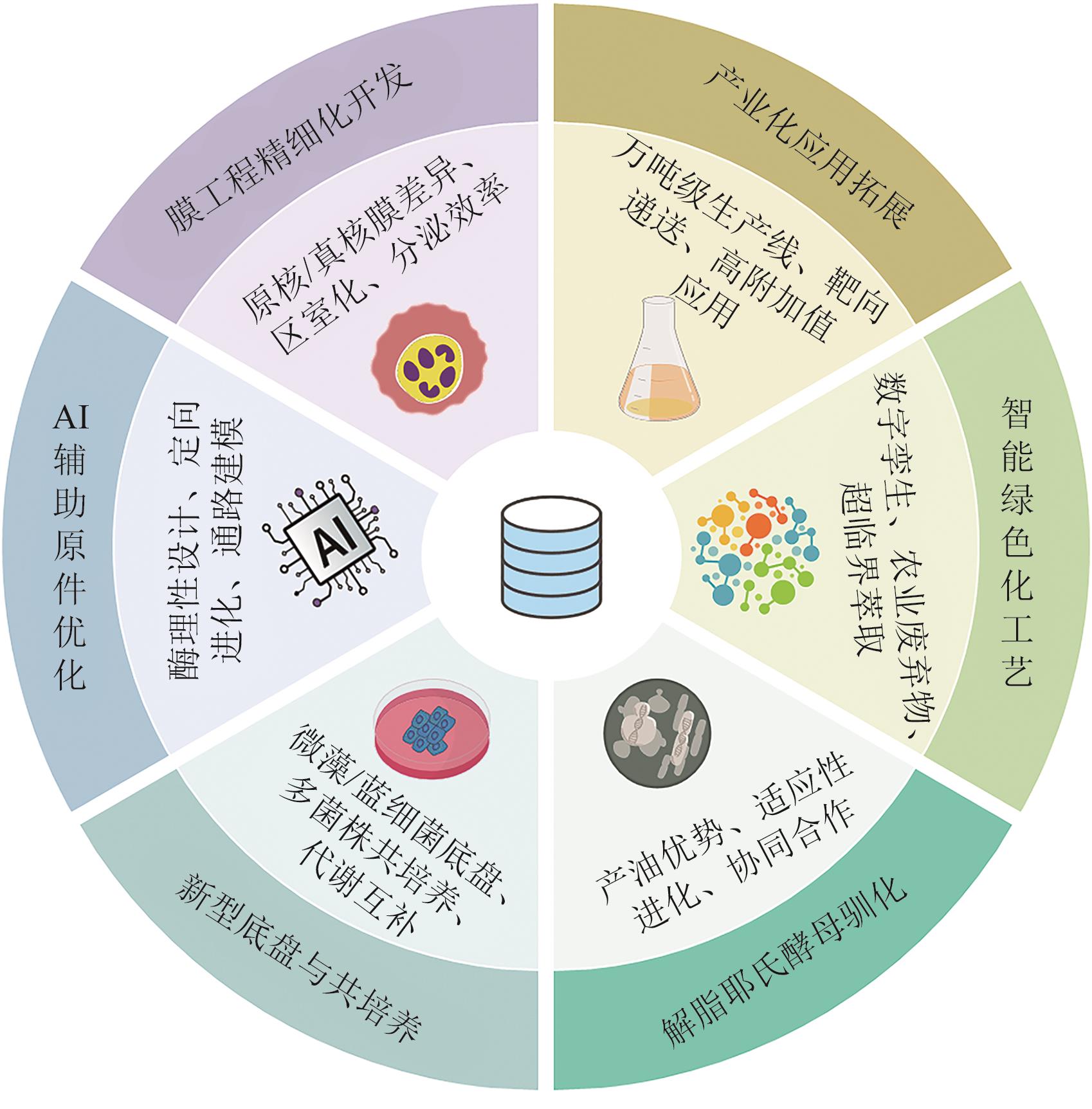
图2 类胡萝卜素细胞工厂未来研究方向
Fig. 2 Future research directions of carotenoid cell factories
| [1] | MAOKA T. Carotenoids as natural functional pigments[J]. J. Nat. Med., 2020, 74(1): 1-16. |
| [2] | 张闯,张玉苍,何连芳.不同微生物生产类胡萝卜素的研究现状[J].食品工业科技,2012,33(6):179-182+187. |
| ZHANG C, ZHANG Y C, HE L F. Research status of carotenoids production by different microorganisms[J]. Sci. Technol. Food Ind., 2012, 33(6): 179-182+187. | |
| [3] | 赵婷,林孔亮,惠伯棣.微生物源类胡萝卜素研究进展[J].食品科学,2010,31(23):462-467. |
| ZHAO T, LIN K L, HUI B D. Research progress in microbial-sourced carotenoids[J]. Food Sci., 2010, 31(23): 462-467. | |
| [4] | RODRIGUEZ-CONCEPCION M, AVALOS J, BONET M L, et al.. A global perspective on carotenoids: metabolism, biotechnology, and benefits for nutrition and health[J]. Nat. Rev. Microbiol., 2018,70: 62-93. |
| [5] | 陈卯森,王育焜,钟洁,等.微生物合成β-胡萝卜素的研究进展[J].食品与发酵工业,2025,51(2):356-364. |
| CHEN M S, WANG Y K, ZHONG J, et al.. Research advances in microbial synthesis of β-carotene[J]. Food Ferment. Ind., 2025, 51(2): 356-364. | |
| [6] | SUN T, YUAN H, CAO H, et al.. Carotenoid metabolism in plants: the role of plastids[J]. Mole. Plant, 2018, 11(1): 58-74. |
| [7] | MA Y, LIU N, GREISEN P, et al.. Removal of lycopene substrate inhibition enables high carotenoid productivity in Yarrowia lipolytica [J/OL]. Nat. Commun., 2022, 13: 572[2026-02-10]. . |
| [8] | FORDJOUR E, BAI Z, LI S, et al.. Improved membrane permeability via hypervesiculation for in situ recovery of lycopene in Escherichia coli [J]. ACS Synth. Biol., 2023, 12(9): 2725-2739. |
| [9] | LYU X, LYU Y, YU H, et al.. Biotechnological advances for improving natural pigment production: a state-of-the-art review[J/OL]. Bioresour. Bioprocess., 2022, 9(1): 8[2026-02-10]. . |
| [10] | XU S, GAO S, AN Y. Research progress of engineering microbial cell factories for pigment production[J/OL]. Biotechnol. Adv., 2023, 65: 108150[2026-02-10]. . |
| [11] | YUAN L Z, ROUVIÈRE P E, LAROSSA R A, et al.. Chromosomal promoter replacement of the isoprenoid pathway for enhancing carotenoid production in E. coli [J]. Metab. Eng., 2006, 8(1): 79-90. |
| [12] | YANG J, GUO L. Biosynthesis of β-carotene in engineered E. coli using the MEP and MVA pathways[J/OL]. Microb. Cell Fact., 2014, 131: 160[2026-02-10]. . |
| [13] | MARTIN V J J, PITERA D J, WITHERS S T, et al.. Engineering a mevalonate pathway in Escherichia coli for production of terpenoids[J]. Nat. Biotechnol., 2003, 21(7): 796-802. |
| [14] | ZHAO J, LI Q, SUN T, et al.. Engineering central metabolic modules of Escherichia coli for improving β-carotene production[J]. Metab. Eng., 2013, 17: 42-50. |
| [15] | YOON S H, LEE S H, DAS A, et al.. Combinatorial expression of bacterial whole mevalonate pathway for the production of β-carotene in E. coli [J]. J. Biotechnol., 2009, 140(3-4): 218-226. |
| [16] | LI Q, FAN F, GAO X, et al.. Balanced activation of IspG and IspH to eliminate MEP intermediate accumulation and improve isoprenoids production in Escherichia coli [J]. Metab. Eng., 2017, 44: 13-21. |
| [17] | LU C H, CHOI J H, ENGELMANN MORAN N, et al.. Laboratory-scale production of 13C-labeled lycopene and phytoene by bioengineered Escherichia coli [J]. J. Agric. Food Chem., 2011, 59(18): 9996-10005. |
| [18] | SUN L, ATKINSON C A, LEE Y G, et al.. High-level β-carotene production from xylose by engineered Saccharomyces cerevisiae without overexpression of a truncated HMG1 (tHMG1)[J]. Biotechnol. Bioeng., 2020, 117(11): 3522-3532. |
| [19] | ABDULLAH C N, LIU M, CHEN Q, et al.. Efficient production of astaxanthin in Yarrowia lipolytica through metabolic and enzyme engineering[J]. Synth. Syst. Biotechnol., 2025, 10(3): 737-750. |
| [20] | AJIKUMAR P K, XIAO W H, TYO K E J, et al.. Isoprenoid pathway optimization for taxol precursor overproduction in Escherichia coli [J]. Science, 2010, 330(6000): 70-74. |
| [21] | COUSSEMENT P, BAUWENS D, MAERTENS J, et al.. Direct combinatorial pathway optimization[J]. ACS Synth. Biol., 2017, 6(2): 224-232. |
| [22] | MITCHELL L A, CHUANG J, AGMON N, et al.. Versatile genetic assembly system (VEGAS) to assemble pathways for expression in S. cerevisiae [J]. Nucleic Acids Res., 2015, 43(13): 6620-6630. |
| [23] | XIE W, LIU M, LYU X, et al.. Construction of a controllable β-carotene biosynthetic pathway by decentralized assembly strategy in Saccharomyces cerevisiae [J]. Biotechnol. Bioeng., 2014, 111(1): 125-133. |
| [24] | JING Y, WANG J, GAO H, et al.. Enhanced β-carotene production in Yarrowia lipolytica through the metabolic and fermentation engineering[J/OL]. J.Ind.Microbiol.Biotechnol., 2023, 50(1): kuad009[2026-02-10]. . |
| [25] | JIN Y, STEPHANOPOULOS G. Multi-dimensional gene target search for improving lycopene biosynthesis in Escherichia coli [J]. Metab. Eng., 2007, 9(4): 337-347. |
| [26] | SUN T, MIAO L, LI Q, et al.. Production of lycopene by metabolically-engineered Escherichia coli [J]. Biotechnol. Lett., 2014, 36(7): 1515-1522. |
| [27] | 赵婧,刘怡,李清艳,等.多个调控元件调控萜类合成途径基因表达提高β-胡萝卜素的生产[J].生物工程学报,2013,29(1):41-55. |
| ZHAO J, LIU Y, LI Q Y, et al.. Modulation of isoprenoid gene expression with multiple regulatory parts for improved β-carotene production[J]. Chin. J. Biotechnol., 2013, 29(1): 41-55. | |
| [28] | ZHANG X K, NIE M Y, CHEN J, et al.. Multicopy integrants of crt genes and co-expression of AMP deaminase improve lycopene production in Yarrowia lipolytica [J]. J. Biotechnol., 2019, 289: 46-54. |
| [29] | ZHOU P, FANG X, XU N, et al.. Development of a highly efficient copper-inducible GAL regulation system (CuIGR) in Saccharomyces cerevisiae [J]. ACS Synth. Biol., 2021, 10(12): 3435-3444. |
| [30] | XIE W, YE L, LYU X, et al.. Sequential control of biosynthetic pathways for balanced utilization of metabolic intermediates in Saccharomyces cerevisiae [J]. Metab. Eng., 2015, 28: 8-18. |
| [31] | GÖTTL V L, SCHMITT I, BRAUN K, et al.. CRISPRi-library-guided target identification for engineering carotenoid production by Corynebacterium glutamicum [J/OL]. Microorganisms, 2021, 9(4): 670[2026-02-10]. . |
| [32] | STEGELMANN F, SEEGER J, PETERS-WENDISCH P, et al.. Production of ultraviolet A protectant C50 carotenoid decaprenoxanthin by metabolically engineered Corynebacterium glutamicum [J/OL]. Bioresour. Technol., 2026, 439: 133319[2026-02-10]. . |
| [33] | WU Y, YAN P, LI Y, et al.. Enhancing β-carotene production in Escherichia coli by perturbing central carbon metabolism and improving the NADPH supply[J/OL]. Front. Bioeng. Biotechnol., 2020, 8: 585[2026-02-10]. . |
| [34] | BOGORAD I W, LIN T S, LIAO J C. Synthetic non-oxidative glycolysis enables complete carbon conservation[J]. Nature, 2013, 502(7473): 693-697. |
| [35] | YE L, ZHANG C, BI C, et al.. Combinatory optimization of chromosomal integrated mevalonate pathway for β-carotene production in Escherichia coli [J/OL]. Microb. Cell Fact., 2016, 15(1): 202[2026-02-10]. . |
| [36] | GUO J Y, HU K L, BI C H, et al.. Construction of an alternative glycerol-utilization pathway for improved β-carotene production in Escherichia coli [J]. J. Ind. Microbiol. Biotechnol., 2018, 45(8): 697-705. |
| [37] | LI K, LI C, LIU C G, et al.. Engineering carbon source division of labor for efficient α-carotene production in Corynebacterium glutamicum [J]. Metab. Eng., 2024, 84: 117-127. |
| [38] | CHOI K R, JANG W D, YANG D, et al.. Systems metabolic engineering strategies: integrating systems and synthetic biology with metabolic engineering[J]. Trends Biotechnol., 2019, 37(8): 817-837. |
| [39] | SANDMANN G. Combinatorial biosynthesis of carotenoids in a heterologous host: a powerful approach for the biosynthesis of novel structures[J/OL]. ChemBioChem, 2002, 3(7): 629[2026-02-10]. . |
| [40] | PARK S Y, BINKLEY R M, KIM W J, et al.. Metabolic engineering of Escherichia coli for high-level astaxanthin production with high productivity[J]. Metab. Eng., 2018, 49: 105-115. |
| [41] | KIM J H, KIM S W, NGUYEN D Q A, et al.. Production of β-carotene by recombinant Escherichia coli with engineered whole mevalonate pathway in batch and fed-batch cultures[J]. Biotechnol. Bioprocess Eng., 2009, 14(5): 559-564. |
| [42] | LARROUDE M, CELINSKA E, BACK A, et al.. A synthetic biology approach to transform Yarrowia lipolytica into a competitive biotechnological producer of β-carotene[J]. Biotechnol. Bioeng., 2018, 115(2): 464-472. |
| [43] | FAN J, ZHANG Y, LI W, et al.. Multidimensional optimization of Saccharomyces cerevisiae for carotenoid overproduction[J/OL]. BioDesign Res., 2024, 6: 26[2026-02-10]. . |
| [44] | 俞国伟.胶红酵母发酵生产类胡萝卜素的研究[D].杭州:浙江工业大学,2014. |
| [45] | ZHENG Q, ZHU K, WANG K, et al.. The photoinduced β-carotene synthesis in Blakeslea trispora is dependent on WC-2A[J/OL]. Front. Microbiol., 2025, 16: 1554367[2026-02-10]. . |
| [46] | LI Y, LIN Z, HUANG C, et al.. Metabolic engineering of Escherichia coli using CRISPR-Cas9 meditated genome editing[J]. Metab. Eng., 2015, 31: 13-21. |
| [47] | WU T, YE L, ZHAO D, et al.. Membrane engineering-a novel strategy to enhance the production and accumulation of β-carotene in Escherichia coli [J]. Metab. Eng., 2017, 43: 85-91. |
| [48] | SOLDAT M, MARKUŠ T, MAGDEVSKA V, et al.. Screening of novel β-carotene hydroxylases for the production of β-cryptoxanthin and zeaxanthin and the impact of enzyme localization and crowding on their production in Yarrowia lipolytica [J/OL]. Microb. Cell Fact., 2024, 23(1): 298[2026-02-10]. . |
| [49] | ZHANG X K, WANG D N, CHEN J, et al.. Metabolic engineering of β-carotene biosynthesis in Yarrowia lipolytica [J]. Biotechnol. Lett., 2020, 42(6): 945-956. |
| [50] | ZHANG X, CHEN S, LIN Y, et al.. Metabolic engineering of Pichia pastoris for high-level production of lycopene[J]. ACS Synth. Biol., 2023, 12(10): 2961-2972. |
| [51] | ZHU M H, ZHOU H Z, LIU Z, et al.. Reprogramming lipid metabolism and morphology engineering in Yarrowia lipolytica for algae-free, high-titer production of esterified astaxanthin[J/OL]. Chem. Eng. J., 2026, 532: 174273[2026-02-10]. . |
| [52] | MITUŁA A, BARSZCZEWSKI W, ROBAK M. Yarrowia lipolytica cell cycle study[J]. Electronic J. Polish Agri. Uni., 2010, 13(2): 08. |
| [53] | FRIEDLANDER J, TSAKRAKLIDES V, KAMINENI A, et al.. Engineering of a high lipid producing Yarrowia lipolytica strain[J/OL]. Biotechnol. Biofuels, 2016, 9: 77[2026-02-10]. . |
| [54] | LIU Y, CUI Y, CHEN J, et al.. Metabolic engineering of Synechocystis sp. PCC6803 to produce astaxanthin[J/OL]. Algal Res., 2019, 44: 101679[2026-02-10]. . |
| [55] | AMENDOLA S, KNEIP J S, MEYER F, et al.. Metabolic engineering for efficient ketocarotenoid accumulation in the green microalga Chlamydomonas reinhardtii [J]. ACS Synth. Biol., 2023, 12(3): 820-831. |
| [56] | STEINBRENNER J, SANDMANN G. Transformation of the green alga Haematococcus pluvialis with a phytoene desaturase for accelerated astaxanthin biosynthesis[J]. Appl. Environ. Microbiol., 2006, 72(12): 7477-7484. |
| [57] | 杨飞.一种虾青素提取用高压均质机的制作方法:CN202420700593.3[P].2026-05-06. |
| [58] | 王颖,曲俊泽,梁楠,等.合成类胡萝卜素细胞工厂的快速构建和定向进化[J].化工进展,2021,40(3):1187-1201. |
| WANG Y, QU J Z, LIANG N, et al.. Rapid construction and directed evolution of cell factories for carotenoid biosynthesis[J]. Chem. Ind. Eng. Prog., 2021, 40(3): 1187-1201. | |
| [59] | WU Z, KAN S B J, LEWIS R D, et al.. Machine learning-assisted directed protein evolution with combinatorial libraries[J]. Proc. Natl. Acad. Sci. U S A, 2019, 116(18): 8852-8858. |
| [60] | VASINA M, VELECKÝ J, PLANAS-IGLESIAS J, et al.. Tools for computational design and high-throughput screening of therapeutic enzymes[J/OL]. Adv. Drug Deliv. Rev., 2022, 183: 114143[2026-02-10]. . |
| [61] | MORI Y, SHIRAI T. Designing artificial metabolic pathways, construction of target enzymes, and analysis of their function[J]. Curr. Opin. Biotechnol., 2018, 54: 41-44. |
| [1] | 杜盈萱, 孙雨彤, 彭瑾瑜, 赵嘉昊, 董柯然, 高鑫源, 吴浩泽, 罗云耀, 穆小苹, 隋宏书. 非哺乳动物模型在预测毒理学中的应用:进展、挑战与展望[J]. 生物技术进展, 2026, 16(3): 610-617. |
| [2] | 赵璇, 刘中雪, 吴玲玲, 苟永明, 刘英杰, 马文建. 解脂耶氏酵母细胞工厂生产重组蛋白的研究进展[J]. 生物技术进展, 2026, 16(3): 562-573. |
| [3] | 韩田杰, 魏金凤, 燕永亮, 林敏, 周正富. 甜菜色素生物合成研究进展[J]. 生物技术进展, 2026, 16(3): 510-522. |
| [4] | 孙雨晴, 彤丽格, 房文霞. 微生物细胞工厂介导的多酶级联反应赋能生物质高值化应用[J]. 生物技术进展, 2026, 16(3): 496-509. |
| [5] | 王晓雨, 崔林, 刘淼, 罗会颖, 姚斌, 王晓璐. 基于微生物细胞工厂的二氧化碳资源化利用研究进展[J]. 生物技术进展, 2026, 16(3): 454-484. |
| [6] | 纪思佳, 张小雪, 翟丽丽, 董静, 李岩异, 常亮. 抗体药物筛选技术的研究进展[J]. 生物技术进展, 2025, 15(1): 43-49. |
| [7] | 张春雷. 病原微生物检测技术研究进展[J]. 生物技术进展, 2024, 14(2): 189-195. |
| [8] | 辛志奇, 赵航, 汪海, 路铁刚. 基于深度学习的作物基因组学和遗传改良[J]. 生物技术进展, 2021, 11(4): 483-488. |
| [9] | 黄丽娜,刘欢,张奋强,姜梦嫣,于跃,周义杰,周王艳,薛飞燕 ,马兰青,. 红景天苷生物合成机制及其基因工程研究进展[J]. 生物技术进展, 2017, 7(2): 106-110. |
| 阅读次数 | ||||||
|
全文 |
|
|||||
|
摘要 |
|
|||||
