

生物技术进展 ›› 2026, Vol. 16 ›› Issue (1): 105-114.DOI: 10.19586/j.2095-2341.2025.0110
李斌1( ), 周玉梅1, 王霞1, 宋志军2, 闫炳雄2()
收稿日期:2025-08-22
接受日期:2025-10-23
出版日期:2026-01-25
发布日期:2026-02-12
通讯作者:
闫炳雄
作者简介:李斌 E-mail: 973826098@qq.com;
基金资助:
Bin LI1(), Yumei ZHOU1, Xia WANG1, Zhijun SONG2, Bingxiong YAN2()
Received:2025-08-22
Accepted:2025-10-23
Online:2026-01-25
Published:2026-02-12
Contact:
Bingxiong YAN
摘要:
为综合评价会宁地区蒲公英的质量特征,建立了高效液相色谱法(high performance liquid chromatography,HPLC)指纹图谱并进行相似度评价分析。采用化学模式识别方法对15批蒲公英进行主成分分析(principal component analysis,PCA)和正交偏最小二乘法-判别分析(orthogonal partial least squares discriminant analysis,OPLS-DA),并结合多成分含量测定,对会宁地区蒲公英的品质进行综合评价。结果表明,蒲公英指纹图谱有20个共有峰,除S3和S12外,其余13批相似度均大于0.89;PCA将15批蒲公英按来源划分为2类,OPLS-DA进一步筛选出5个差异性标志物,分别是咖啡酸、新绿原酸、阿魏酸、菊苣酸和绿原酸,且差异显著性排序为咖啡酸>新绿原酸>阿魏酸>菊苣酸>绿原酸;含量测定结果显示,蒲公英菊苣酸含量均达到药典规定标准,且栽培种植蒲公英中的咖啡酸和菊苣酸普遍高于野生蒲公英。研究建立的蒲公英质量综合评价方法能有效分析不同批次蒲公英质量的差异性,为蒲公英的质量评价、栽培种植以及健康产品开发提供科学依据。
中图分类号:
李斌, 周玉梅, 王霞, 宋志军, 闫炳雄. 基于HPLC指纹图谱和化学计量学的蒲公英质量评价研究[J]. 生物技术进展, 2026, 16(1): 105-114.
Bin LI, Yumei ZHOU, Xia WANG, Zhijun SONG, Bingxiong YAN. Study on Quality Evaluation of Dandelion Based on HPLC Fingerprint and Chemometrics[J]. Current Biotechnology, 2026, 16(1): 105-114.
| 编号 | 样品来源 | 编号 | 样品来源 |
|---|---|---|---|
| S1 | 会师镇野生蒲公英 | S9 | 郭城驿野生蒲公英 |
| S2 | 会师镇野生蒲公英 | S10 | 老君坡镇种植蒲公英 |
| S3 | 杨崖集镇野生蒲公英 | S11 | 老君坡镇种植蒲公英 |
| S4 | 中川镇野生蒲公英 | S12 | 太平店镇种植蒲公英 |
| S5 | 新塬镇野生蒲公英 | S13 | 太平店镇种植蒲公英 |
| S6 | 白草塬镇野生蒲公英 | S14 | 甘肃蒲岳农业科技开发有限公司 |
| S7 | 大沟镇野生蒲公英 | S15 | 甘肃蒲岳农业科技开发有限公司 |
| S8 | 大沟镇野生蒲公英 |
表 1 蒲公英样品来源信息
Table 1 Origin information form of dandelion
| 编号 | 样品来源 | 编号 | 样品来源 |
|---|---|---|---|
| S1 | 会师镇野生蒲公英 | S9 | 郭城驿野生蒲公英 |
| S2 | 会师镇野生蒲公英 | S10 | 老君坡镇种植蒲公英 |
| S3 | 杨崖集镇野生蒲公英 | S11 | 老君坡镇种植蒲公英 |
| S4 | 中川镇野生蒲公英 | S12 | 太平店镇种植蒲公英 |
| S5 | 新塬镇野生蒲公英 | S13 | 太平店镇种植蒲公英 |
| S6 | 白草塬镇野生蒲公英 | S14 | 甘肃蒲岳农业科技开发有限公司 |
| S7 | 大沟镇野生蒲公英 | S15 | 甘肃蒲岳农业科技开发有限公司 |
| S8 | 大沟镇野生蒲公英 |
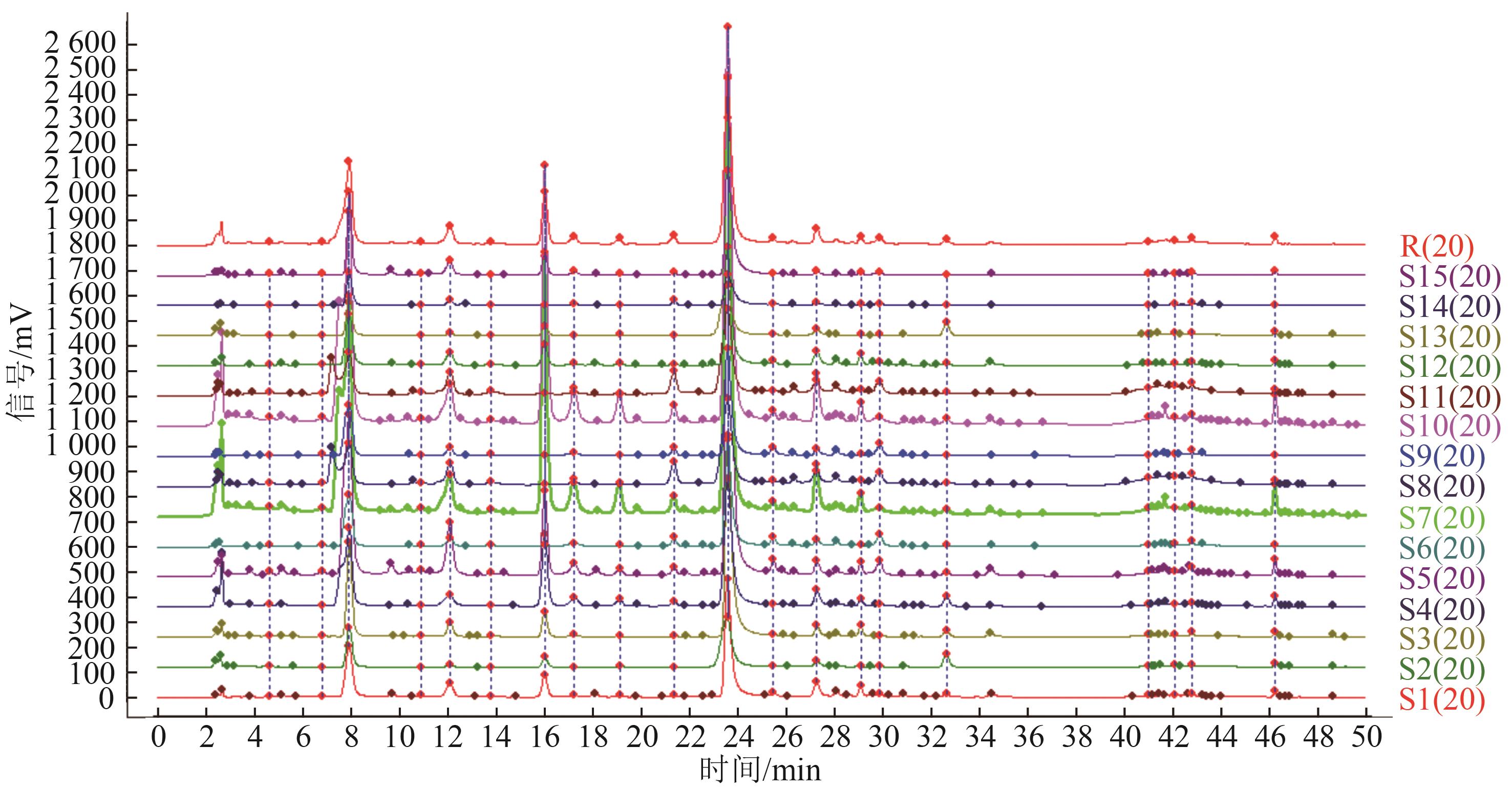
图 1 15批蒲公英样品HPLC指纹图谱
Fig. 1 HPLC fingerprints of 15 batches of dandelion
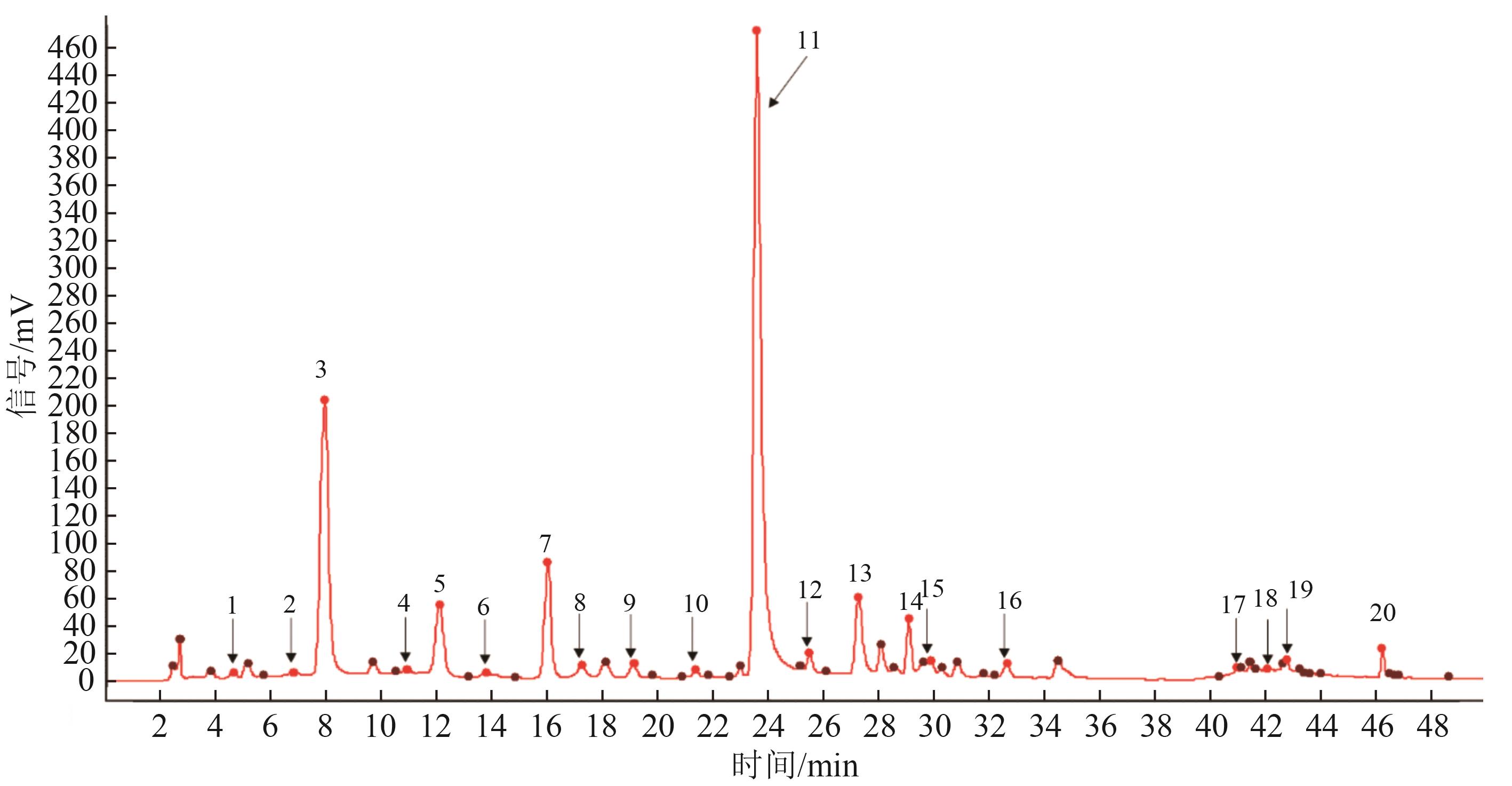
图 2 蒲公英对照特征HPLC图注:3—新绿原酸;5—绿原酸;7—咖啡酸;11—菊苣酸;12—阿魏酸;13—异绿原酸B;14—异绿原酸A;15—芦丁;16—槲皮素;17—木犀草素;18—山奈酚;19—芹菜素。
Fig. 2 HPLC chromatogram of characteristic comparison of dandelion
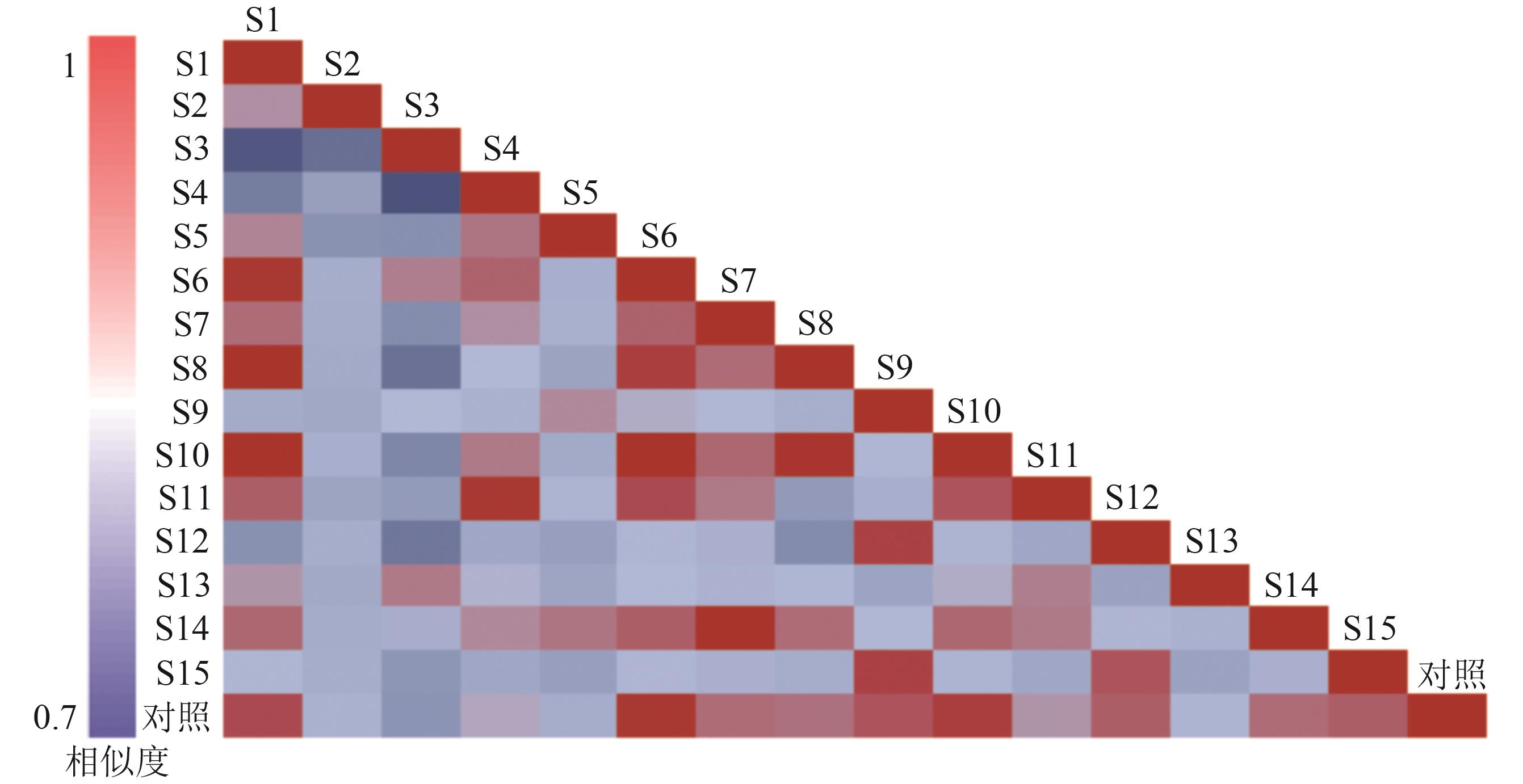
图3 15批蒲公英药材相似度评价热图
Fig. 3 Heatmap of similarity evaluation of 15 batches of dandelion
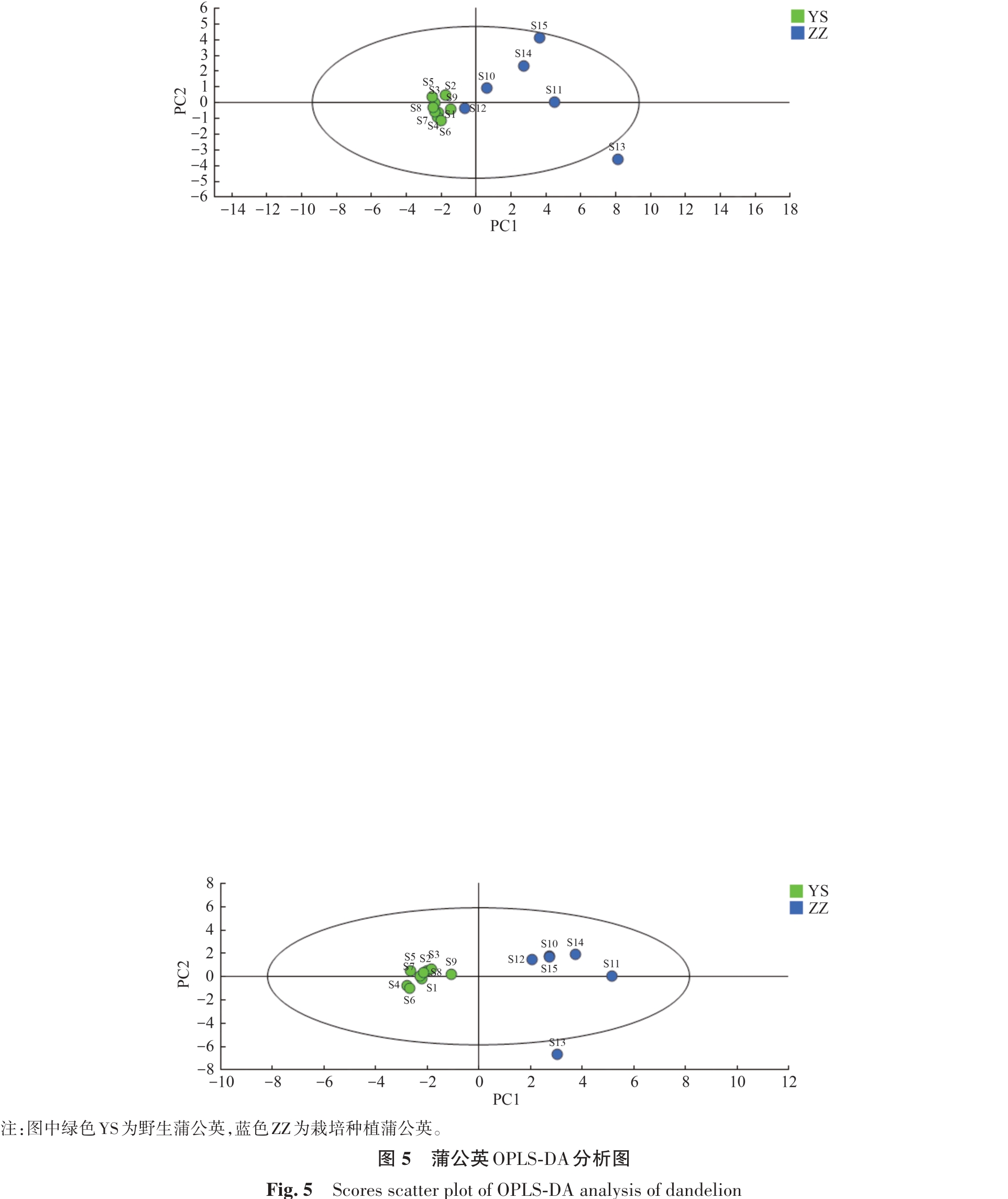
图 4 蒲公英PCA分析图注:图中绿色YS为野生蒲公英,蓝色ZZ为栽培种植蒲公英。
Fig. 4 PCA score plot of dandelion
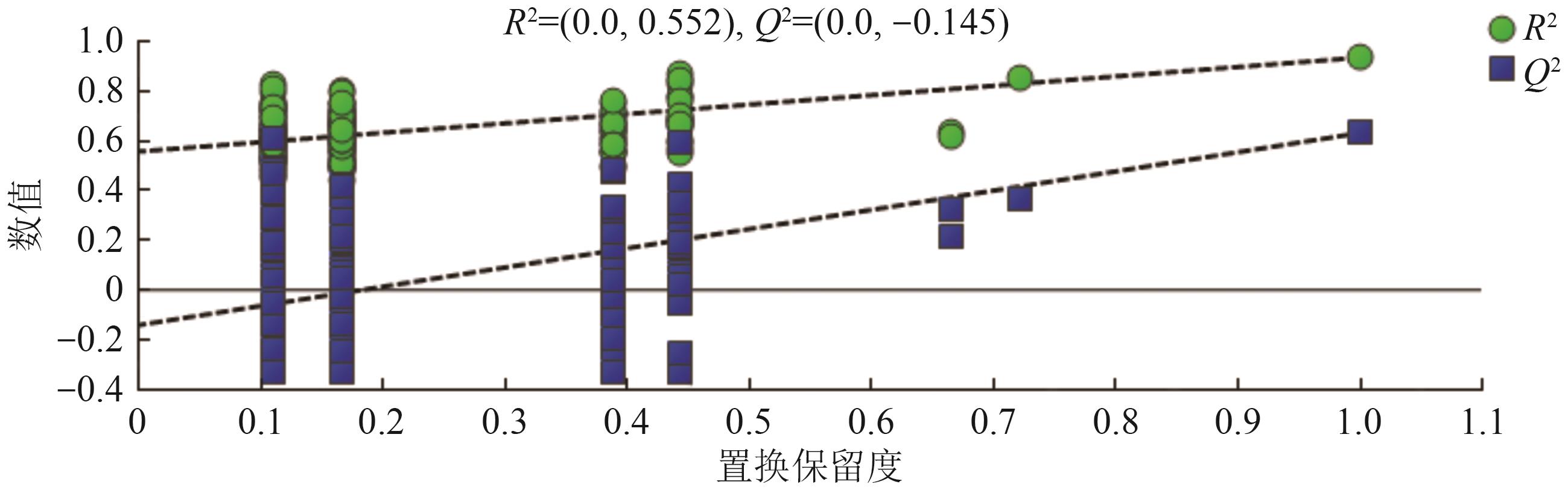
图 6 OPLS-DA 置换检测结果图
Fig. 6 OPLS-DA replacement detection results
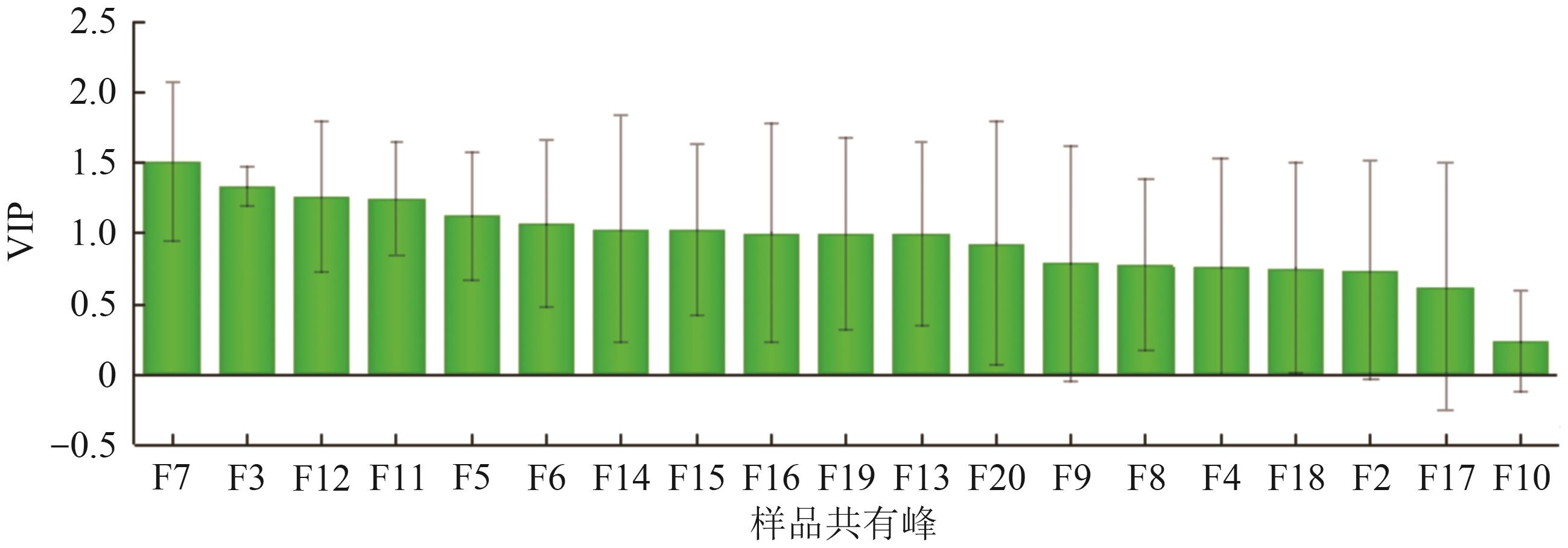
图7 S1~S15样品共有峰的VIP图
Fig. 7 VIP chart of each component of S1~S15 samples
| 对照品 | 标准曲线方程式 | R2 | 线性范围/(mg·mL-1) |
|---|---|---|---|
| 新绿原酸 | y=27 415 774x-45 572 | 0.999 6 | 0.140~1.402 |
| 绿原酸 | y=27 469 882x-57 778 | 0.999 5 | 0.181~1.810 |
| 咖啡酸 | y=4 698 948x-2 997 | 0.999 7 | 0.232~2.321 |
| 菊苣酸 | y=39 487 351x+65 292 | 0.999 6 | 0.135~1.352 |
| 阿魏酸 | y=18 989 323x-23 578 | 0.999 8 | 0.152~1.520 |
| 异绿原酸B | y=26 742 352x+47 252 | 0.999 5 | 0.119~1.190 |
| 异绿原酸A | y=10 823 104x-14 278 | 0.999 7 | 0.124~1.243 |
| 芦丁 | y=2 821 032x+4 651 | 0.999 8 | 0.128~1.282 |
| 槲皮素 | y=2 496 454x+1 987 | 0.999 8 | 0.145~1.450 |
| 木犀草素 | y=465 648x-2 341 | 0.999 9 | 0.136~1.365 |
| 山奈酚 | y=978 532x-4 657 | 0.999 6 | 0.148~1.482 |
| 芹菜素 | y=1 227 312x-1 044 | 0.999 6 | 0.155~1.550 |
表2 对照品线性关系及线性范围
Table 2 Regression equations of reference substances
| 对照品 | 标准曲线方程式 | R2 | 线性范围/(mg·mL-1) |
|---|---|---|---|
| 新绿原酸 | y=27 415 774x-45 572 | 0.999 6 | 0.140~1.402 |
| 绿原酸 | y=27 469 882x-57 778 | 0.999 5 | 0.181~1.810 |
| 咖啡酸 | y=4 698 948x-2 997 | 0.999 7 | 0.232~2.321 |
| 菊苣酸 | y=39 487 351x+65 292 | 0.999 6 | 0.135~1.352 |
| 阿魏酸 | y=18 989 323x-23 578 | 0.999 8 | 0.152~1.520 |
| 异绿原酸B | y=26 742 352x+47 252 | 0.999 5 | 0.119~1.190 |
| 异绿原酸A | y=10 823 104x-14 278 | 0.999 7 | 0.124~1.243 |
| 芦丁 | y=2 821 032x+4 651 | 0.999 8 | 0.128~1.282 |
| 槲皮素 | y=2 496 454x+1 987 | 0.999 8 | 0.145~1.450 |
| 木犀草素 | y=465 648x-2 341 | 0.999 9 | 0.136~1.365 |
| 山奈酚 | y=978 532x-4 657 | 0.999 6 | 0.148~1.482 |
| 芹菜素 | y=1 227 312x-1 044 | 0.999 6 | 0.155~1.550 |
| 编号 | 新绿原酸 | 绿原酸 | 咖啡酸 | 菊苣酸 | 阿魏酸 | 异绿原酸B | 异绿原酸A | 芦丁 | 槲皮素 | 木犀草素 | 山奈酚 | 芹菜素 |
|---|---|---|---|---|---|---|---|---|---|---|---|---|
| S1 | 0.716 | 0.410 | 0.376 | 5.569 | 0.059 | 0.040 | 0.153 | 3.162 | 1.386 | 0.042 | 0.089 | 0.465 |
| S2 | 0.516 | 0.285 | 0.260 | 4.948 | 0.012 | 0.013 | 0.109 | 6.009 | 4.209 | 0.114 | 0.186 | 0.102 |
| S3 | 0.805 | 0.360 | 0.304 | 6.018 | 0.011 | 0.056 | 0.087 | 8.023 | 2.233 | 0.221 | 0.078 | 0.989 |
| S4 | 0.911 | 0.238 | 0.407 | 5.778 | 0.038 | 0.084 | 0.011 | 9.106 | 4.325 | 0.192 | 0.059 | 0.322 |
| S5 | 0.708 | 0.168 | 0.520 | 4.831 | 0.002 | 0.038 | 0.095 | 4.006 | 1.238 | 0.110 | 0.204 | 0.251 |
| S6 | 0.502 | 0.506 | 0.414 | 4.507 | 0.003 | 0.093 | 0.124 | 5.992 | 3.413 | 0.136 | 0.065 | 0.578 |
| S7 | 0.120 | 0.402 | 0.370 | 4.943 | 0.019 | 0.013 | 0.044 | 6.237 | 6.187 | 0.132 | 0.208 | 0.249 |
| S8 | 0.094 | 0.660 | 0.654 | 5.529 | 0.005 | 0.013 | 0.308 | 4.851 | 5.279 | 0.118 | 0.185 | 0.423 |
| S9 | 0.021 | 0.335 | 0.416 | 8.459 | 0.025 | 0.068 | 0.151 | 6.050 | 2.366 | 0.015 | 0.135 | 0.895 |
| S10 | 0.030 | 0.430 | 0.337 | 6.650 | 0.061 | 0.117 | 0.110 | 4.781 | 5.444 | 0.096 | 0.173 | 0.484 |
| S11 | 0.043 | 0.795 | 0.352 | 5.277 | 0.031 | 0.064 | 0.098 | 3.850 | 4.560 | 0.109 | 0.434 | 0.359 |
| S12 | 0.044 | 0.652 | 0.615 | 4.705 | 0.182 | 0.425 | 0.035 | 4.097 | 2.159 | 0.147 | 0.248 | 0.344 |
| S13 | 0.431 | 0.509 | 0.480 | 7.852 | 0.235 | 0.114 | 0.324 | 3.255 | 3.129 | 0.067 | 0.227 | 0.704 |
| S14 | 0.202 | 0.585 | 0.426 | 9.472 | 0.055 | 0.044 | 0.177 | 7.043 | 1.955 | 0.105 | 0.207 | 0.806 |
| S15 | 0.101 | 0.622 | 0.434 | 8.068 | 0.096 | 0.186 | 0.108 | 4.949 | 6.197 | 0.132 | 0.318 | 0.554 |
| 平均 | 0.350 | 0.464 | 0.424 | 6.174 | 0.056 | 0.091 | 0.129 | 5.427 | 3.605 | 0.116 | 0.188 | 0.502 |
表 3 样品成分含量测定结果 (mg·g-1)
Table 3 Test results of component content
| 编号 | 新绿原酸 | 绿原酸 | 咖啡酸 | 菊苣酸 | 阿魏酸 | 异绿原酸B | 异绿原酸A | 芦丁 | 槲皮素 | 木犀草素 | 山奈酚 | 芹菜素 |
|---|---|---|---|---|---|---|---|---|---|---|---|---|
| S1 | 0.716 | 0.410 | 0.376 | 5.569 | 0.059 | 0.040 | 0.153 | 3.162 | 1.386 | 0.042 | 0.089 | 0.465 |
| S2 | 0.516 | 0.285 | 0.260 | 4.948 | 0.012 | 0.013 | 0.109 | 6.009 | 4.209 | 0.114 | 0.186 | 0.102 |
| S3 | 0.805 | 0.360 | 0.304 | 6.018 | 0.011 | 0.056 | 0.087 | 8.023 | 2.233 | 0.221 | 0.078 | 0.989 |
| S4 | 0.911 | 0.238 | 0.407 | 5.778 | 0.038 | 0.084 | 0.011 | 9.106 | 4.325 | 0.192 | 0.059 | 0.322 |
| S5 | 0.708 | 0.168 | 0.520 | 4.831 | 0.002 | 0.038 | 0.095 | 4.006 | 1.238 | 0.110 | 0.204 | 0.251 |
| S6 | 0.502 | 0.506 | 0.414 | 4.507 | 0.003 | 0.093 | 0.124 | 5.992 | 3.413 | 0.136 | 0.065 | 0.578 |
| S7 | 0.120 | 0.402 | 0.370 | 4.943 | 0.019 | 0.013 | 0.044 | 6.237 | 6.187 | 0.132 | 0.208 | 0.249 |
| S8 | 0.094 | 0.660 | 0.654 | 5.529 | 0.005 | 0.013 | 0.308 | 4.851 | 5.279 | 0.118 | 0.185 | 0.423 |
| S9 | 0.021 | 0.335 | 0.416 | 8.459 | 0.025 | 0.068 | 0.151 | 6.050 | 2.366 | 0.015 | 0.135 | 0.895 |
| S10 | 0.030 | 0.430 | 0.337 | 6.650 | 0.061 | 0.117 | 0.110 | 4.781 | 5.444 | 0.096 | 0.173 | 0.484 |
| S11 | 0.043 | 0.795 | 0.352 | 5.277 | 0.031 | 0.064 | 0.098 | 3.850 | 4.560 | 0.109 | 0.434 | 0.359 |
| S12 | 0.044 | 0.652 | 0.615 | 4.705 | 0.182 | 0.425 | 0.035 | 4.097 | 2.159 | 0.147 | 0.248 | 0.344 |
| S13 | 0.431 | 0.509 | 0.480 | 7.852 | 0.235 | 0.114 | 0.324 | 3.255 | 3.129 | 0.067 | 0.227 | 0.704 |
| S14 | 0.202 | 0.585 | 0.426 | 9.472 | 0.055 | 0.044 | 0.177 | 7.043 | 1.955 | 0.105 | 0.207 | 0.806 |
| S15 | 0.101 | 0.622 | 0.434 | 8.068 | 0.096 | 0.186 | 0.108 | 4.949 | 6.197 | 0.132 | 0.318 | 0.554 |
| 平均 | 0.350 | 0.464 | 0.424 | 6.174 | 0.056 | 0.091 | 0.129 | 5.427 | 3.605 | 0.116 | 0.188 | 0.502 |
| [1] | 李若婷.蒲公英开发利用研究进展[J].中国林副特产,2024, 2:85-88. |
| LI R T. Research progress on development and vtilization of Dandelion[J]. Forest By-Product and Speciality in China, 2024, 2: 85-88. | |
| [2] | 国家药典委员会,中华人民共和国药典(第一部)[M].中国医药科技出版社:北京,2020. |
| [3] | 张雪.遮光对蒲公英生长及主要活性成分积累的影响[D]. 哈尔滨:东北林业大学,2023. |
| [4] | 刘亦菲,刘兆薇,任一冉,等.蒲公英化学成分、药理作用研究进展及质量标志物预测分析[J].中华中医药学刊,2024,42(8):132-141. |
| LIU Y F, LIU Z W, REN Y R, et al.. Research progress in chemical composition and pharmacological effects of Pugongying (Taraxacum officinale) and predictive analysis of quality markers[J]. Chin. Arch. Tradit. Chin. Med., 2024, 42(8): 132-141. | |
| [5] | 李文静,王艳萍,刘荣宏,等.高效液相色谱法测定蒲公英中5种成分的含量[J].中医临床研究,2024,16(6):16-20. |
| LI W J, WANG Y P, LIU R H, et al.. Determination of five components in Pugongying by HPLC[J]. Clin. J. Chin. Med., 2024, 16(6): 16-20. | |
| [6] | 戴明鋆,蒋毅,陈玥章,等.西藏林芝地区反苞蒲公英主要化学成分分析[J].中国农学通报,2025,41(13):71-79. |
| DAI M J, JIANG Y, CHEN Y Z, et al.. Analysis of main chemical compositions content of Taraxacum grypodon in Linzhi of Tibet[J]. Chin. Agric. Sci. Bull., 2025, 41(13): 71-79. | |
| [7] | 闫志华,周骏辉,华羽彤,等.UPLC同时测定不同产地蒲公英中6种成分含量[J].现代中药研究与实践,2025,39(2):44-48. |
| YAN Z H, ZHOU J H, HUA Y T, et al.. Simultaneous determination of 6 components in Taraxacum mongolicum from different habitats by UPLC[J]. Res. Pract. Chin. Med., 2025, 39(2): 44-48. | |
| [8] | DENG X, JIAO Y, HAO H, et al.. Dandelion extract suppresses the stem-like properties of triple-negative breast cancer cells by regulating CUEDC2/β-catenin/OCT4 signaling axis[J/OL]. J. Ethnopharmacol., 2025, 342: 119408[2025-12-21]. . |
| [9] | LAILA U, KAUR J, SHARMA K, et al.. Dandelion (Taraxacum officinale): a promising source of nutritional and therapeutic compounds[J]. Recent Adv. Food Nutr. Agric., 2025, 16(1): 41-56. |
| [10] | RADOMAN K, ZIVKOVIC V, ZDRAVKOVIC N, et al.. Effects of dandelion root on rat heart function and oxidative status[J/OL]. BMC Complement. Med. Ther., 2023, 23(1): 78[2025-12-21]. . |
| [11] | WANG R, LI W, FANG C, et al.. Extraction and identification of new flavonoid compounds in dandelion Taraxacum mongolicum Hand.-Mazz. with evaluation of antioxidant activities[J/OL]. Sci. Rep., 2023, 13(1): 2166[2025-12-21]. . |
| [12] | MIŁEK M, MARCINČÁKOVÁ D, LEGÁTH J. Polyphenols content, antioxidant activity, and cytotoxicity assessment of Taraxacum officinale extracts prepared through the micelle-mediated extraction method[J/OL]. Molecules, 2019, 24(6): 1025[2025-12-21]. . |
| [13] | WESTERMAN L, RODDICK J G. Annual variation in sterol levels in leaves of Taraxacum officinale weber[J]. Plant Physiol., 1981, 68(4): 872-875. |
| [14] | 姜雪冰,王知斌,孙延平,等.东北蒲公英根的化学成分研究[J].中成药,2023,45(6):1887-1891. |
| JIANG X B, WANG Z B, SUN Y P, et al.. Chemical constituents from the roots of Taraxacum ohwianum [J]. Chin. Tradit. Pat. Med., 2023, 45(6): 1887-1891. | |
| [15] | 杜盼,朱坤,陈丽艳.蒲公英三萜类化合物的抗肿瘤作用研究状况[J].中国临床药理学杂志,2022,38(17):2098-2101. |
| DU P, ZHU K, CHEN L Y. Research status of antitumor effects of Taraxacum triterpenoids [J]. Chin. J. Clin. Pharmacol., 2022, 38(17): 2098-2101. | |
| [16] | ATALLAH A M, NICHOLAS H J. 31-nordihydrolanosterol, a minor 4-alpha-methyl sterol in pollen of Taraxacum dens Leonis [J]. Steroids, 1971, 17(6): 611-618. |
| [17] | GE B J, ZHAO P, LI H T, et al.. Taraxacum mongolicum protects against Staphylococcus aureus-infected mastitis by exerting anti-inflammatory role via TLR2-NF-κB/MAPKs pathways in mice[J/OL]. J. Ethnopharmacol., 2021, 268: 113595[2025-12-21]. . |
| [18] | DÍAZ K, ESPINOZA L, MADRID A, et al.. Isolation and identification of compounds from bioactive extracts of Taraxacum officinale weber ex F. H. wigg. (dandelion) as a potential source of antibacterial agents[J/OL]. Evid. Based Compl. Alternat. Med., 2018, 2018: 2706417[2025-12-21]. |
| [19] | ZHUANG X, SHI W, SHEN T, et al.. Research updates and advances on flavonoids derived from dandelion and their antioxidant activities[J/OL]. Antioxidants, 2024, 13(12): 1449[2025-12-21]. . |
| [20] | LIU F J, YANG J, CHEN X Y, et al.. Chemometrics integrated with in silico pharmacology to reveal antioxidative and anti-inflammatory markers of dandelion for its quality control[J/OL]. Chin. Med., 2022, 17(1): 125[2025-12-21]. . |
| [21] | 程筱阳,万琪林,胡栋宝,等.冲泡条件对蒲公英茶抗氧化活性及有效成分的影响[J].食品安全质量检测学报,2025,16(4):243-253. |
| CHENG X Y, WAN Q L, HU D B, et al.. Effects of brewing conditions on the antioxidant activities and bioactive components of Taraxacum mongolicum tea[J]. J. Food Saf. Qual., 2025, 16(4): 243-253. | |
| [22] | 闫炳雄,宋姗珊,吴云秋,等.不同国家(地区)穿心莲的质量评价[J].中国现代中药,2024,26(11):1867-1874. |
| YAN B X, SONG S S, WU Y Q, et al.. Quality evaluation of Andrographis paniculata from different countries and regions[J]. Mod. Chin. Med., 2024, 26(11): 1867-1874. | |
| [23] | 王婷格,罗陆遥,薛瑞,等.基于HPLC指纹图谱和多成分含量测定结合化学计量学的盐杜仲质量评价研究[J].中国中药杂志,2024(1):141-150. |
| WANG T G, LUO L Y, XUE R, et al.. Quality evaluation of salt-fired Eucommiae cortex based on HPLC fingerprint, multi-component content determination, and chemometrics[J]. China J. Chin. Mater. Med., 2024(1): 141-150. | |
| [24] | 邵淑贤,徐梦婷,林燕萍,等.基于电子鼻与HS-SPME-GC-MS技术对不同产地黄观音乌龙茶香气差异分析[J].食品科学,2023,44(4):232-239. |
| SHAO S X, XU M T, LIN Y P, et al.. Differential analysis of aroma components of Huangguanyin oolong tea from different geographical origins using electronic nose and headspace solid-phase microextraction-gas chromatography-mass spectrometry[J]. Food Sci., 2023, 44(4): 232-239. | |
| [25] | 方朝缵,何荣荣,甘力帆,等.基于UPLC指纹图谱的穿心莲不同部位化学成分差异研究[J].中国医药导报,2023,20(19):24-29. |
| FANG C Z, HE R R, GAN L F, et al.. Study on chemical constituents of different parts of Andrographis paniculata based on UPLC fingerprint[J]. China Med. Her., 2023, 20(19): 24-29. | |
| [26] | 赵贵琴,冷崇姣,赵悦,等.高效液相色谱法测定蒲公英中菊苣酸含量的不确定度评定[J].中国药业,2023,32(23):92-95. |
| ZHAO G Q, LENG C J, ZHAO Y, et al.. Uncertainty evaluation of content determination of cichoric acid in Taraxaci herba by HPLC[J]. China Pharm., 2023, 32(23): 92-95. | |
| [27] | 许扬,周扬刚,丁芹,等.蒲公英及其配方颗粒的高效液相色谱指纹图谱研究[J].壮瑶药研究,2023(2):105-112. |
| XU Y, ZHOU Y G, DING Q, et al.. Study on high performance liquid chromatography fingerprint of dandelion and its formula granules[J]. Res. Zhuang Yao Ethn. Med., 2023(2): 105-112. | |
| [28] | 卢秋红,孙梦秋,包明,等.HPLC法同时测定蒲公英中4种活性成分的含量[J].食品与药品,2023,25(1):85-88. |
| LU Q H, SUN M Q, BAO M, et al.. Simultaneous determination of four kinds of active components in taraxaci herba by HPLC[J]. Food Drug, 2023, 25(1): 85-88. | |
| [29] | 胡山丹,春花,红艳,等.蒲公英HPLC指纹图谱研究及3个成分的含量测定[J].中国处方药,2023,21(4):35-38. |
| HU S D, CHUN H, HONG Y, et al.. Study on HPLC fingerprint of Taraxacum mongolicum and determination of three components[J]. J. China Prescr. Drug, 2023, 21(4): 35-38. | |
| [30] | 孟然,吴哲,冯薇,等.基于HPLC指纹图谱结合化学模式识别及多成分定量的蒲公英质量评价研究[J].中草药,2022,53(24):7887-7896. |
| MENG R, WU Z, FENG W, et al.. Quality evaluation of dandelion based on HPLC fingerprint combined with chemical pattern recognition and multi-component determination[J]. Chin. Tradit. Herb. Drugs, 2022, 53(24): 7887-7896. | |
| [31] | 李健华,黄锦波.高效液相色谱法测定蒲公英提取物中10种活性物质[J].化学分析计量,2022,31(10):49-53. |
| LI J H, HUANG J B. Determination of 10 active substances in dandelion extract by high performance liquid chromatography[J]. Chem. Anal. Meterage, 2022, 31(10): 49-53. | |
| [32] | 李娟,张昱.不同采期蒲公英有效成分含量分析[J].农业科技与信息,2023(3):150-153. |
| LI J, ZHANG Y. Analysis of effective components in Taraxacum mongolicum in different harvest periods[J]. Agric. Sci. Technol. Inf., 2023(3): 150-153. | |
| [33] | 王傲迪,李涛,张良明,等.紫锥菊不同生长期菊苣酸含量变化及干燥方式对其含量的影响[J].生物化工,2022,8(3):87-89. |
| WANG A D, LI T, ZHANG L M, et al.. Changes of cichoric acid content in Echinacea purpurea in different seasons and the effect of drying methods on its content[J]. Biol. Chem. Eng., 2022, 8(3): 87-89. | |
| [34] | 杨建,何倩,吴娜,等.毛菊苣不同部位中菊苣酸、绿原酸、单咖啡酰酒石酸的含量测定[J].新疆医科大学学报,2020,43(6):792-795. |
| YANG J, HE Q, WU N, et al.. Determination of chicoric acid, monocaffeyltartaric acid and chicoric acid in different parts of Cichorium glandulosum Boiss.et Huet[J]. J. Xinjiang Med. Univ., 2020, 43(6): 792-795. | |
| [35] | 王红,冯帅,史磊,等.菊苣酸的研究进展[J].药学研究,2021,40(9):614-619. |
| WANG H, FENG S, SHI L, et al.. Research progress of cichoric acid[J]. J. Pharm. Res., 2021, 40(9): 614-619. |
| No related articles found! |
| 阅读次数 | ||||||
|
全文 |
|
|||||
|
摘要 |
|
|||||
