

生物技术进展 ›› 2026, Vol. 16 ›› Issue (4): 744-755.DOI: 10.19586/j.2095-2341.2026.0130
张华1( ), 张雨腾2,3, 裴欣瑶1, 杨立桃2,3()
收稿日期:2026-06-01
接受日期:2026-07-31
出版日期:2026-07-25
发布日期:2026-09-11
通信作者:
杨立桃
作者简介:张华 E-mail: gmotest@126.com;
基金资助:
Hua ZHANG1(), Yuteng ZHANG2,3, Xinyao PEI1, Litao YANG2,3()
Received:2026-06-01
Accepted:2026-07-31
Online:2026-07-25
Published:2026-09-11
Contact:
Litao YANG
摘要:
随着转基因作物商业化规模持续扩大及基因编辑等新型生物技术的迅速应用,新型生物技术产品种类日益复杂、多样,构建灵敏、准确、可溯源的新型生物技术产品检测方法和体系已成为保障食品安全、支撑标签管理与监管执法的重要基础。系统综述了2025年转基因、基因编辑等新型生物技术产品检测领域的研究进展,重点涵盖样品前处理、核酸扩增检测(实时荧光定量PCR、数字PCR)、等温扩增、成簇规律间隔短回文重复序列及其相关蛋白(clustered regularly interspaced short palindromic repeats-Cas protein,CRISPR/Cas)辅助检测、生物传感与免疫检测、高通量测序,以及数据库与监管支撑体系等方面。总体而言,实时荧光定量PCR仍是转基因成分定量分析的核心方法;数字PCR在低拷贝靶标绝对定量检测和参考物质定值中优势突出;等温扩增与生物传感技术持续推动检测向快速化、现场化方向发展;高通量测序正为基因编辑产品识别提供更高分辨率的技术支撑。未来,相关检测技术将进一步朝多技术联用、多靶标同步识别、智能化分析与监管适配并行的方向演进。
中图分类号:
张华, 张雨腾, 裴欣瑶, 杨立桃. 转基因与基因编辑产品检测方法研究进展[J]. 生物技术进展, 2026, 16(4): 744-755.
Hua ZHANG, Yuteng ZHANG, Xinyao PEI, Litao YANG. Research Progress on Detection Methods of Genetically Modified and Gene-edited Products[J]. Current Biotechnology, 2026, 16(4): 744-755.
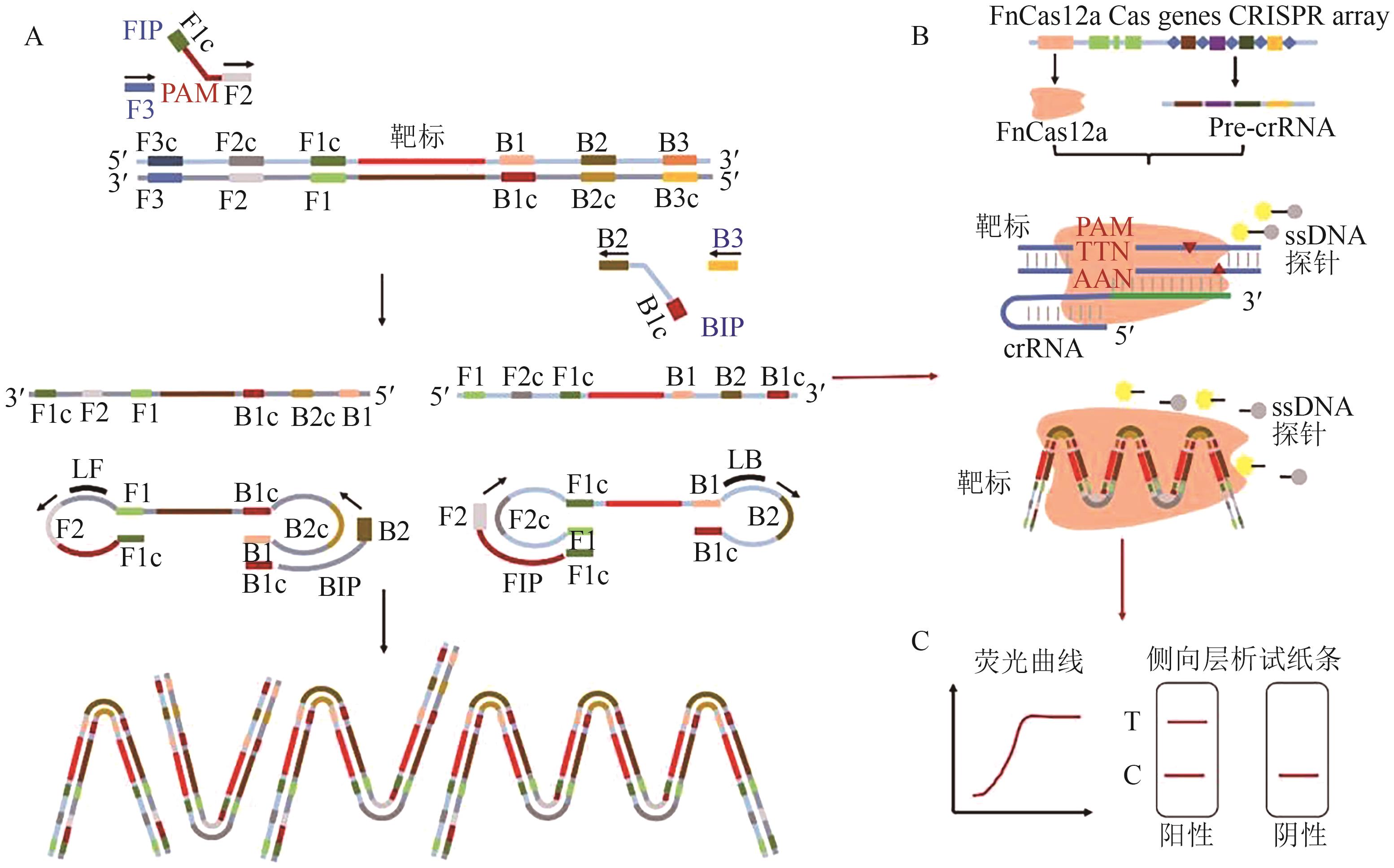
图1 Cas-pfLAMP用于转基因玉米和大豆检测的原理示意图[20]A:LAMP扩增原理;B:CRISPR/FnCas12a对扩增产物的识别及顺式、反式切割过程;C:检测结果输出方式
Fig. 1 Schematic diagram of the principle of Cas-pfLAMP for detecting genetically modified maize and soybean[20]
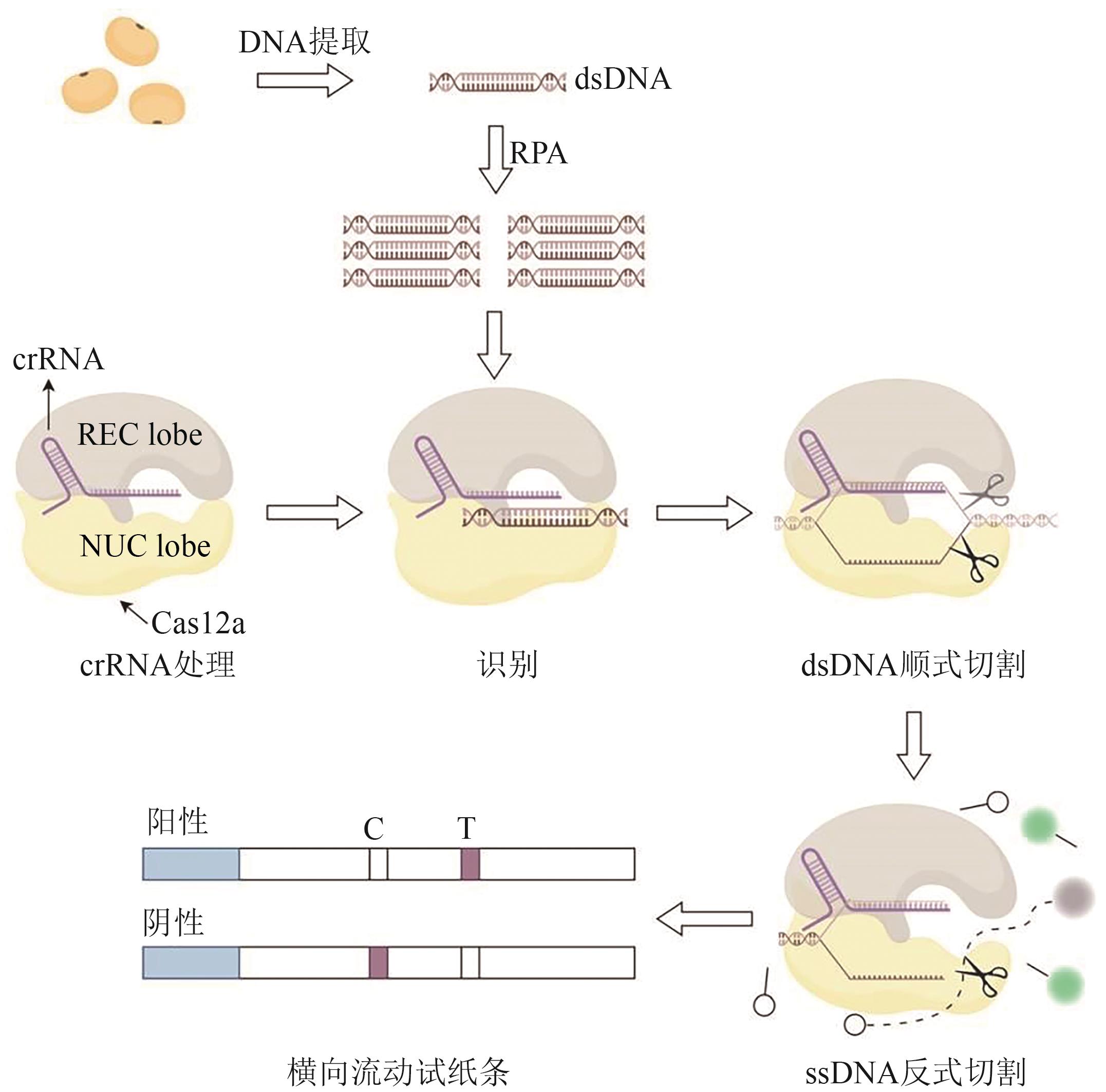
图2 基于RPA-CRISPR/Cas12a的转基因大豆中黄6106检测原理示意图[21]
Fig. 2 Schematic diagram of ZH6106 detection principle in transgenic soybeans based on RPA-CRISPR/Cas12a[21]
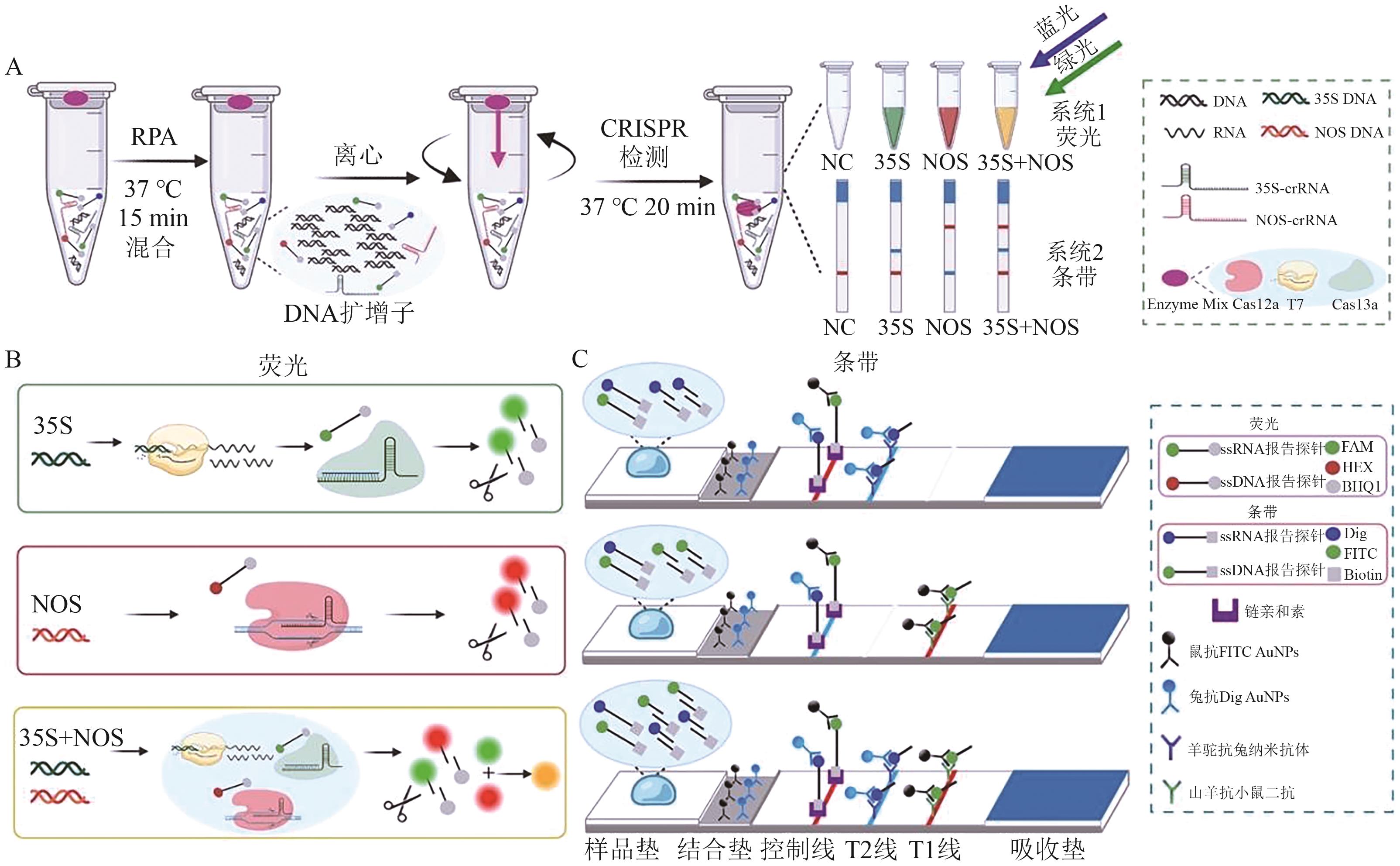
图3 MR-DCA用于CaMV35S和NOS检测的原理示意图[24]A:MR-DCA整体检测流程与结果判读;B:CaMV 35S和NOS靶标的双通道荧光检测原理;C:侧向层析试纸条检测原理
Fig. 3 Schematic diagram of MR-DCA for the detection of CaMV35S and NOS[24]
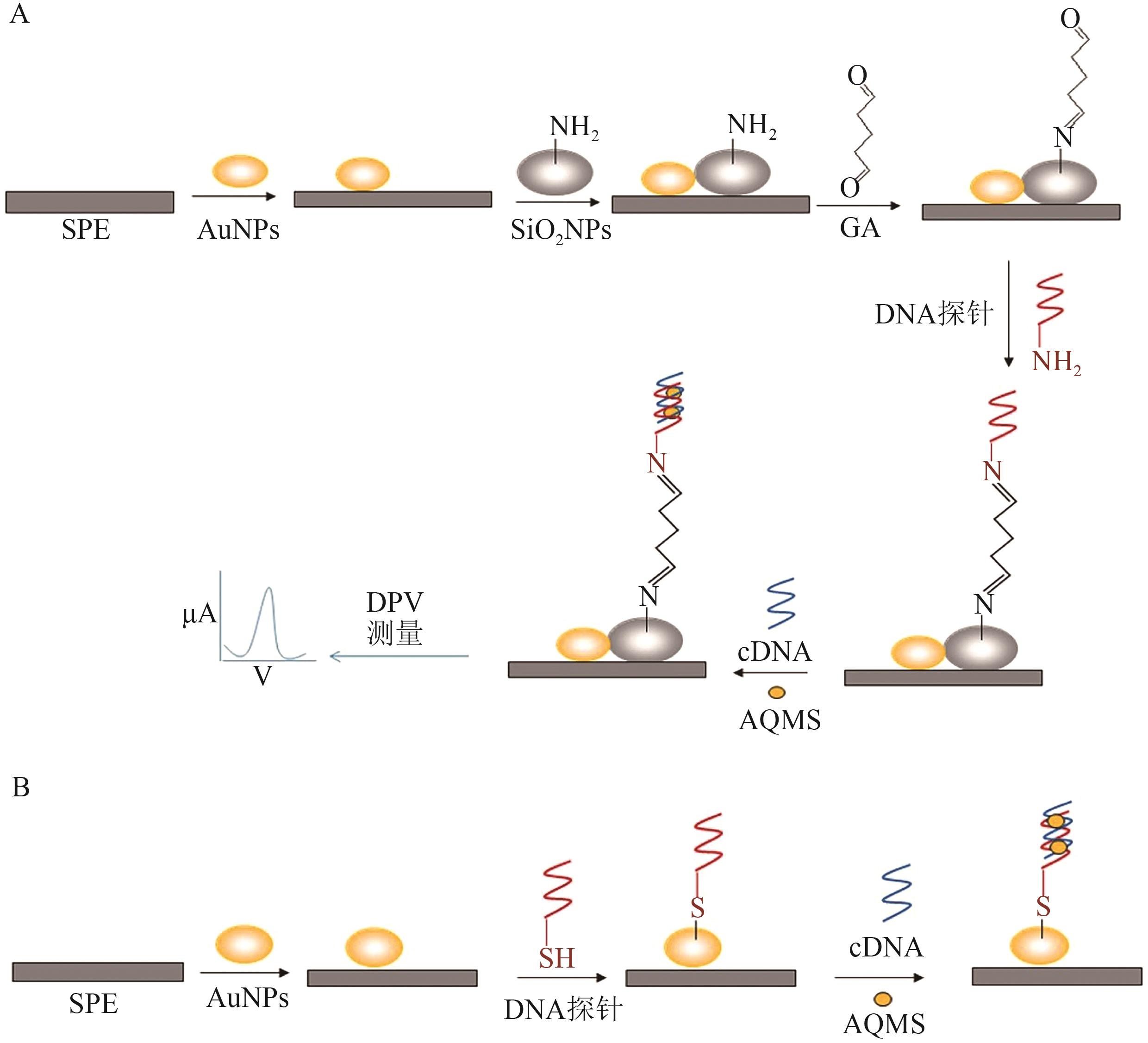
图4 基于SiO2-Au 纳米复合电极的伏安法基因传感器构建与检测原理示意图[31]A:SiO2-Au纳米复合电极的构建、DNA探针固定及靶标杂交检测流程,SPE—固相萃取(solid-phase extraction),DPV—差分脉冲伏安法(differential pulse voltammetry);B:AuNPs修饰电极的DNA探针固定及靶标杂交检测流程
Fig. 4 Schematic diagram of construction and detection principle of voltammetric gene sensor based on SiO2-Au nanocomposite electrode[31]
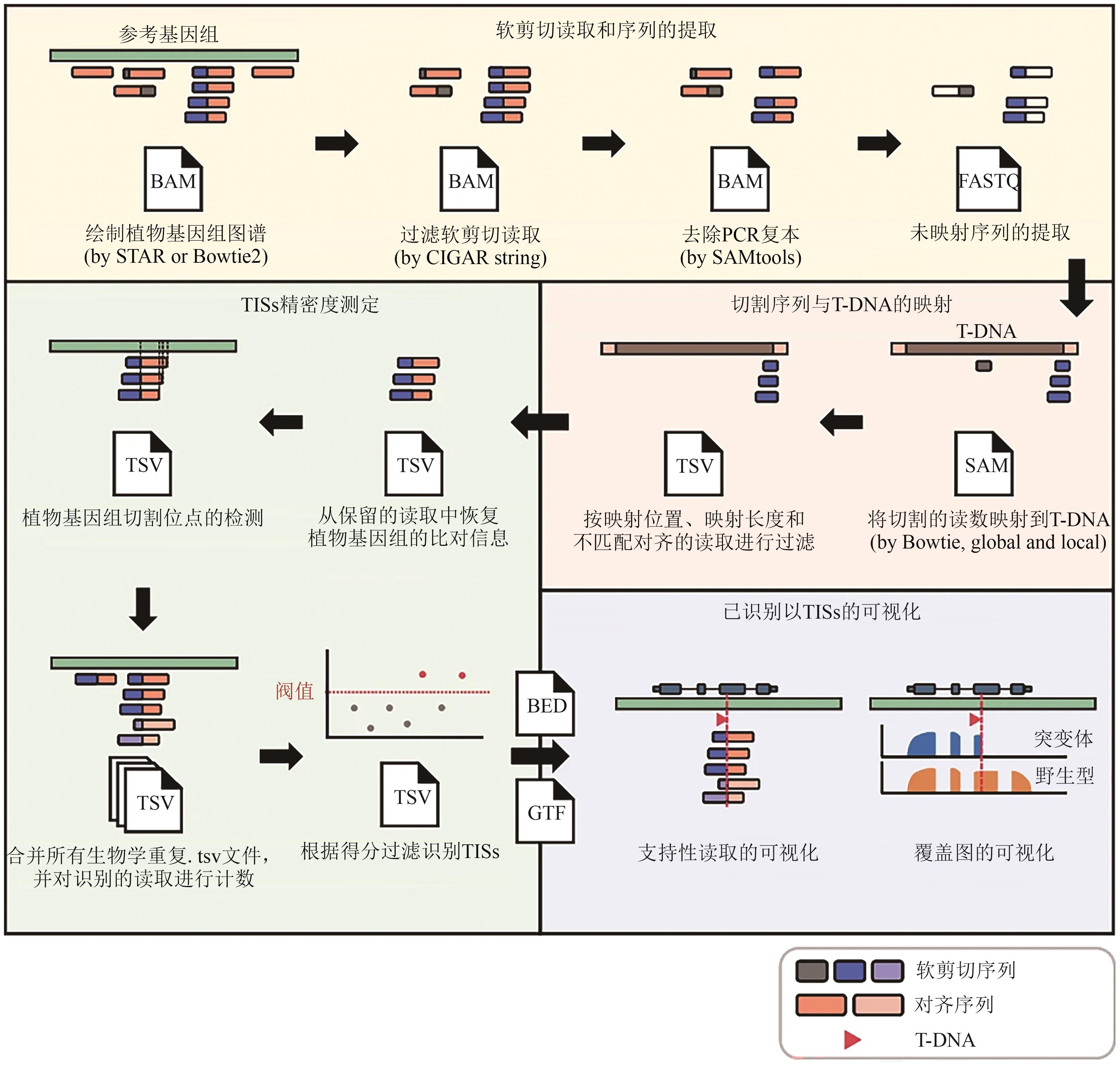
图5 T-DNA reader识别T-DNA插入位点的分析流程示意图[35]注:STAR、Bowtie2和SAMtools为序列比对及比对文件处理工具;CIGAR sting为BAM文件中描述比对关系的字段;BAM、FASTQ、SAM、TSV、BED和GTF为常用生物信息学文件格式。
Fig. 5 Schematic diagram of the analysis process for T-DNA reader to identify T-DNA insertion sites
| 技术类别 | 代表方法 | 主要优势 | 主要局限性 | 适用场景 |
|---|---|---|---|---|
| 普通PCR | 元件特异性PCR、构建特异性PCR、事件特异性PCR、多重PCR | 操作相对简单、成本较低,适合已知靶标的快速初筛和基础鉴定 | 以定性或半定量分析为主,对低拷贝靶标和复杂基质样品的定量能力有限 | 转基因元件筛查、事件初步确认、未授权成分定性筛查 |
| qPCR | TaqMan探针qPCR、双重qPCR、多重qPCR | 灵敏度和特异性较高,定量能力成熟,标准化程度高,是监管检测中的核心方法 | 依赖标准曲线和参考物质;对单碱基编辑、小片段变异等靶标的识别能力受引物探针设计影响较大 | 转基因成分定量分析、事件特异性检测、监管阈值判定 |
| dPCR | ddPCR、芯片数字PCR、腔室数字PCR | 可实现绝对定量,无需标准曲线,适用于低拷贝、低丰度和复杂基质样品 | 仪器和耗材成本较高,通量和多重检测能力受平台限制,跨平台标准化仍需完善 | 低拷贝靶标定量、标准物质定值、基因编辑缺失位点精准识别 |
| 等温扩增 | LAMP、RPA、ERA等 | 反应条件简单、扩增速度快,对仪器依赖较低,便于现场快速检测 | 非特异性扩增和污染风险相对较高,定量能力和结果标准化程度通常弱于qPCR/dPCR | 现场筛查、口岸快速检测、基层实验室快速预警 |
| CRISPR/Cas辅助检测 | LAMP-CRISPR/Cas、RPA-CRISPR/Cas、ERA-CRISPR/Cas、多重CRISPR检测 | 兼具扩增快速性和CRISPR/Cas识别特异性,可与荧光、侧向层析和手机判读结合 | 体系设计较复杂,对crRNA、PAM、酶活性和反应条件依赖较强,多靶标定量和标准化验证仍需加强 | 转基因快速筛查、多靶标联检、现场可视化检测 |
| 免疫检测与生物传感 | 免疫层析试纸条、荧光侧向流免疫分析、电化学基因传感器、光谱融合检测 | 检测速度快、操作便捷,可实现可视化、便携化或无损识别,适合现场应用 | 多数方法依赖高质量抗体、探针或传感界面,对复杂基质干扰和结果定量稳定性要求较高 | 性状蛋白快速筛查、加工样品初筛、现场判读和快速分流 |
| 高通量测序与生物信息学分析 | 靶向测序、低深度NGS、长读长测序、RNA-seq、双链测序、遗传指纹分析 | 可同时获得插入位点、侧翼序列、突变类型和遗传背景信息,分辨率高,适合未知样品和基因编辑产品分析 | 成本、数据分析和数据库依赖较高,对结果解释、溯源判定和监管标准化提出更高要求 | 未知转基因事件识别、插入结构解析、基因编辑产品溯源和多位点分子指纹构建 |
表1 转基因与基因编辑产品主要检测技术的方法学比较
Table 1 Methodological comparison of main detection techniques for genetically modified and gene edited products
| 技术类别 | 代表方法 | 主要优势 | 主要局限性 | 适用场景 |
|---|---|---|---|---|
| 普通PCR | 元件特异性PCR、构建特异性PCR、事件特异性PCR、多重PCR | 操作相对简单、成本较低,适合已知靶标的快速初筛和基础鉴定 | 以定性或半定量分析为主,对低拷贝靶标和复杂基质样品的定量能力有限 | 转基因元件筛查、事件初步确认、未授权成分定性筛查 |
| qPCR | TaqMan探针qPCR、双重qPCR、多重qPCR | 灵敏度和特异性较高,定量能力成熟,标准化程度高,是监管检测中的核心方法 | 依赖标准曲线和参考物质;对单碱基编辑、小片段变异等靶标的识别能力受引物探针设计影响较大 | 转基因成分定量分析、事件特异性检测、监管阈值判定 |
| dPCR | ddPCR、芯片数字PCR、腔室数字PCR | 可实现绝对定量,无需标准曲线,适用于低拷贝、低丰度和复杂基质样品 | 仪器和耗材成本较高,通量和多重检测能力受平台限制,跨平台标准化仍需完善 | 低拷贝靶标定量、标准物质定值、基因编辑缺失位点精准识别 |
| 等温扩增 | LAMP、RPA、ERA等 | 反应条件简单、扩增速度快,对仪器依赖较低,便于现场快速检测 | 非特异性扩增和污染风险相对较高,定量能力和结果标准化程度通常弱于qPCR/dPCR | 现场筛查、口岸快速检测、基层实验室快速预警 |
| CRISPR/Cas辅助检测 | LAMP-CRISPR/Cas、RPA-CRISPR/Cas、ERA-CRISPR/Cas、多重CRISPR检测 | 兼具扩增快速性和CRISPR/Cas识别特异性,可与荧光、侧向层析和手机判读结合 | 体系设计较复杂,对crRNA、PAM、酶活性和反应条件依赖较强,多靶标定量和标准化验证仍需加强 | 转基因快速筛查、多靶标联检、现场可视化检测 |
| 免疫检测与生物传感 | 免疫层析试纸条、荧光侧向流免疫分析、电化学基因传感器、光谱融合检测 | 检测速度快、操作便捷,可实现可视化、便携化或无损识别,适合现场应用 | 多数方法依赖高质量抗体、探针或传感界面,对复杂基质干扰和结果定量稳定性要求较高 | 性状蛋白快速筛查、加工样品初筛、现场判读和快速分流 |
| 高通量测序与生物信息学分析 | 靶向测序、低深度NGS、长读长测序、RNA-seq、双链测序、遗传指纹分析 | 可同时获得插入位点、侧翼序列、突变类型和遗传背景信息,分辨率高,适合未知样品和基因编辑产品分析 | 成本、数据分析和数据库依赖较高,对结果解释、溯源判定和监管标准化提出更高要求 | 未知转基因事件识别、插入结构解析、基因编辑产品溯源和多位点分子指纹构建 |
| [1] | XIA Y, GUO M, LIU K, et al.. Magnetic nanoparticle-based DNA isolation from refined soybean oil: a cost-effective approach for GM testing[J/OL]. Foods, 2025, 14(18): 3186[2026-03-20]. . |
| [2] | CHEN L, LI Q, QU G, et al.. In-situ fixation (ISF): a rapid, reusable, and high-throughput nucleic acid extraction method for plant molecular analysis[J/OL]. Biosens Bioelectron., 2025, 278: 117344[2026-03-20]. . |
| [3] | 杨洋,刘慧敏,林俐,等一种高通量快速提取植物基因组DNA的方法 [J].生物技术通报,2025,41(10):156-163. |
| YANG Y, LIU H M, LIN L, et al.. A high-throughput and rapid method for plant genomic DNA extraction[J]. Biotechnol. Bull., 2025, 41(10): 156-163. | |
| [4] | AINI M K NUR, NORLIA B, NORWATI A, et al.. PCR detection method of herbicide-tolerant eucalyptus event 751K032[J]. Trans. Malays. Soc. Plant Physiol., 32: 92. |
| [5] | PARK S, LEE S, SOHN S I, et al.. Specific detection of genetically modified potatoes containing asparagine synthetase-1 and polyphenol oxidase 5 genes derived from potato[J]. Gm Crops & Food 2025, 16(1): 318-328. |
| [6] | ARSHAD E, BALAN R K, GEMMEL M, et al.. Development and validation of robust real-time PCR assays for genetically modified plants using CaMV 35S, FMV 34S, and T-Nos markers[J]. J. Plant Biochem. Biotechnol., 2025, 34(4): 957-968. |
| [7] | LI W, JIN W, DONG M, et al.. Establishment of an event-specific quantitative real-time PCR method for genetically modified maize LD05 with combined insect resistance and herbicide tolerance[J]. J. Consum. Prot. Food Saf., 2025, 20(4): 407-417. |
| [8] | 农业农村部.农业农村部公告第864号[Z].北京:中华人民共和国农业农村部,2024. |
| [9] | 农业农村部.中华人民共和国农业农村部公告第1012号[Z].北京:农业农村部,2026. |
| [10] | YAO X, LI J, WAN D, et al.. A rapid and cost-effective approach for quantifying the content of genetically modified organism to facilitate the enforcement of labeling regulation[J/OL]. Microchem. J., 2025, 214: 114066[2026-03-20]. . |
| [11] | HEINZ S, NEUSIUS D, ECKERMANN K N, et al.. Development and in-house validation of two real-time PCR methods for the detection of genome-editing events in soybean FAD2 gene variants[J]. J. Consum. Prot. Food Saf., 2025, 20(1): 53-62. |
| [12] | ZANATTA C B, NARENDJA F, JAWHARY H E, et al.. Suitability of real-time PCR methods for new genomic technique detection in the context of the European regulations: a case study in Arabidopsis [J/OL]. Int. J. Mol. Sci., 2025, 26(7): 3308[2026-03-20]. . |
| [13] | SINGH M, SHIWAN I, AMINEDI R, et al.. Detection method for CRISPR-Cas9 edited tomato with single nucleotide deletion using multiplex probe-based real-time PCR and confirmation of non-transgenicity: a case study[J/OL]. J. Genet. Eng. Biotechnol., 2025, 23(4): 100609[2026-03-20]. . |
| [14] | WANG C, LI R, LIU N, et al.. Digital PCR-based characterization of a Zhonghuang 6106 soybean genomic DNA reference material for its food and feed detection[J/OL]. Sci. Rep., 2025, 15(1): 34593[2026-03-20]. . |
| [15] | KIM E H, CHO Y S, KIM B, et al.. Development of a duplex chamber digital PCR to quantify twelve genetically modified maize events[J]. GM Crops & Food, 2025, 16(1): 527-538. |
| [16] | DEMEKE T, ENG M. Detection of soybean GMO events using two multiplex droplet digital PCR assays[J]. J. Aoac Int., 2025, 108(1): 23-28. |
| [17] | VERGINELLI D, CIUFFA S, SPINELLA K, et al.. Comparison of two digital PCR platforms for quantification of genetically modified soybean events[J]. GM Crops & Food, 2025, 16(1): 890-902. |
| [18] | WANG K, JI Y, PENG C, et al.. A novel quantification method for gene-edited animal detection based on ddPCR[J/OL]. Biology, 2025, 14(2): 203[2026-03-20]. . |
| [19] | PARK S B, SUH S M, KIM H J, et al.. Establishment of a screening method for genetically modified potatoes using multiplex PCR[J]. Food Sci. Biotechnol., 2025, 34(12): 2971-2977. |
| [20] | CHEN L, WANG C, ZHU Z, et al.. Field-deployable detection of genetically modified organisms with an integrated method of loop-mediated isothermal amplification and CRISPR/FnCas12a[J]. J. Agric. Food Chem., 2025, 73(9): 5625-5634. |
| [21] | TAO R, ZHANG J, MENG L, et al.. A rapid field-visualization detection platform for genetically modified soybean 'Zhonghuang 6106' based on RPA-CRISPR[J/OL]. Int. J. Mol. Sci., 2025, 26(1): 108[2026-03-20].. |
| [22] | ZHU L, WEI F, WU C, et al.. On-site visualization and sensing platform for detecting genetically modified Papaya “55-1” in Papaya-derived products[J]. J. Agric. Food Chem., 2025, 73(41): 26388-26399. |
| [23] | LIANG Q, WANG X, XIE Q, et al.. Development of highly sensitive one-pot ERA-CRISPR assays for on-site detection of CaMV35S promoter and NOS terminator in genetically modified crops[J/OL]. Food Control, 2025, 170: 111049[2026-03-20]. . |
| [24] | DING L, WANG X, CHEN X, et al.. Development of a novel Cas13a/Cas12a-mediated 'one-pot' dual detection assay for genetically modified crops[J]. J. Adv. Res., 2025, 72: 97-106. |
| [25] | WANG J, LUO J, LIU H, et al.. “Blue-red-purple” multicolored lateral flow immunoassay for simultaneous detection of GM crops utilizing RPA and CRISPR/Cas12a[J/OL]. Talanta, 2025, 282: 127010[2026-03-20]. . |
| [26] | CHI J, WEI Y, CHEN J, et al. A novel vortexing-driven droplet digital CRISPR (VTD-CRISPR) platform for rapid and absolute quantitative detection of genetically modified crops[J/OL]. Chem. Eng. J., 2025, 523: 168333[2026-03-20]. . |
| [27] | LUO B, WANG F, WANG Q, et al.. Development of an immunochromatographic strip for rapid detection of recombinant rice EPSPS in transgenic crops[J/OL]. Anal. Biochem., 2025, 705: 115923[2026-03-20]. . |
| [28] | ZENG H, ZHANG Y, ZHANG M, et al. A signal enhanced lateral flow immunoassay based on core-shell quantum dots labeled antibody and antigen for sensitive detection of CP4-EPSPS protein[J/OL]. Microchem. J., 2025, 209: 112758[2026-03-20]. . |
| [29] | ZENG H, ZHANG Y, ZHOU X, et al.. A lateral flow biosensor based on metal enhanced fluorescence effect for sensitive detection of CP4-EPSPS in genetically modified crops[J/OL]. Food Biosci., 2025, 73: 107721[2026-03-20]. . |
| [30] | KUPREŠANIN A, PAVLOVIĆ M, ŠAŠIĆ ZORIĆ L, et al.. Advanced nanomaterial-based electrochemical biosensing of loop-mediated isothermal amplification products[J/OL]. Biosensors, 2025, 15(9):584[2026-03-20]. . |
| [31] | TAN L L, FUTRA D, HENG L Y, et al.. Voltammetric genosensor from silica nanocomposites for transgenic soybean analysis[J/OL]. J. Food Compos. Anal., 2025, 140: 107277[2026-03-20]. . |
| [32] | HE X, WANG M, YOU J, et al.. Detection of adulteration of non-transgenic soybean oil with transgenic soybean oil by integrating absorption, scattering with fluorescence spectroscopy[J]. J. Food Meas. Charact., 2025, 19(2): 1446-1457. |
| [33] | COTTENET G, BLANCPAIN C, PRUVOST S. An ampliSeq™ HD approach for specific and sensitive identification of GMO by next generation sequencing[J/OL]. J. Food Compos. Anal., 2025, 139: 107038[2026-03-20]. . |
| [34] | QI X, ZHAO X, LYU M, et al.. Efficient transgenic maize (Zea Mays L.) detection using low-depth next-generation sequencing[J/OL]. Sci. Rep., 2025, 15(1): 37593[2026-03-20]. |
| [35] | LEE H, SEO P J. T-DNAreader: fast and precise identification of T-DNA insertion sites in plant genomes using RNA sequencing data[J/OL]. Genome Biol., 2025, 26(1): 199[2026-03-20]. . |
| [36] | HU Y K, LEE J K, SHIN Y G, et al.. Rapid detection of transgene insertion patterns in living modified Phalaenopsis via inverse PCR and nanopore sequencing validated against Illumina and PacBio sequencing platforms[J]. Plant Biotechnol. Rep., 2025, 19(6): 763-775. |
| [37] | BONFINI L, COLAIACOVO M, SAVINI C, et al.. A duplex sequencing approach for high-sensitivity detection of genome-edited plants[J/OL]. Food Chem. Mol. Sci., 2025, 11: 100278[2026-03-20]. . |
| [38] | FRAITURE M A, D'AES J, GOBBO A, et al.. Genetic fingerprints derived from genome database mining allow accurate identification of genome-edited rice in the food chain via targeted high-throughput sequencing[J/OL]. Food Res. Int., 2025, 221: 117218[2026-03-20]. . |
| [39] | LIN H H, CHUNG H Y, LIN T H, et al.. BioInnovate AI: a machine learning platform for rapid PCR assay design in emerging infectious disease diagnostics[J/OL]. Diagnostics, 2025, 15(12): 1445[2026-03-20]. . |
| [40] | XUE M, GONZALEZ D H, OSIKPA E, et al.. Rapid and automated interpretation of CRISPR-Cas13-based lateral flow assay test results using machine learning[J]. Sens. Diagn., 2025, 4(2): 171-181. |
| [41] | HAN G R, GONCHAROV A, ERYILMAZ M, et al. Machine learning in point-of-care testing: innovations, challenges, and opportunities[J/OL]. Nat. Commun., 2025, 16(1): 3165[2026-03-20]. . |
| [42] | DAGAND E, PRINS T W, ADAMSE P, et al.. EUginius: a comprehensive database facilitating GMO detection and identification[J]. J. Consum. Prot. Food Saf., 2025, 20(4): 423-428. |
| [43] | COLAIACOVO M, BONFINI L, MARETTI M, et al.. Retrieving sequences of genetically modified plants from public databases to widen screening approaches[J]. J. Consum. Prot. Food Saf., 2026, 21(1): 41-51. |
| [44] | WEIDNER C, LIESKE K, DAGAND E, et al.. Minimum performance requirements for analytical methods of GMO testing: supplement on digital PCR and recommendations for detection of new genomics techniques and GM animals[J]. J. Consum. Prot. Food Saf., 2025, 20(2): 187-189. |
| [45] | BROLL H, BENDIEK J, BRAEUNING A, et al.. Current status and trends in the analysis of GMO and new genomic techniques[J]. J. Consum. Prot. Food Saf., 2025, 20(1): 89-92. |
| [46] | HUBAR-KOłODZIEJCZYK A, PURNHAGEN K P. Regulatory requirements for the identification, detection and quantification of gene-edited products in light of the (R) evolution of new genomic techniques: state of the art and prospects for changes[J]. Euro. J. Risk Regulation, 2025, 16(4): 1375-1391. |
| [1] | 周佳奕, 朱梨梨, 何龚雯, 姜大刚. CRISPR/Cas系统在转基因作物检测中的应用和展望[J]. 生物技术进展, 2026, 16(4): 756-764. |
| [2] | 李仪扬, 周执政, 王淑菲, 刘博雅, 刘宇飞, 李孝彦, 隋宏书, 刘东巍. CRISPR/Cas9基因编辑技术在疾病治疗中的应用与展望[J]. 生物技术进展, 2025, 15(1): 35-42. |
| [3] | 胡广, 王智, 付伟, 石雨婷, 陈珊珊, 罗亮, 魏霜. 基于TaqMan-qPCR技术的OsWx基因编辑水稻检测方法的建立[J]. 生物技术进展, 2025, 15(1): 86-92. |
| [4] | 王晶, 关海涛, 张晓磊, 王堡槐, 刘宝海, 温洪涛. 农业基因编辑产品检测动态及发展趋势[J]. 生物技术进展, 2024, 14(5): 712-723. |
| [5] | 贾名扬, 王磊, 陈俊峰, 张家庆, 闫祥洲, 邢宝松, 王璟. CRISPR/Cas9基因编辑技术在畜禽育种中的研究进展[J]. 生物技术进展, 2024, 14(4): 529-536. |
| [6] | 宋辉, 曹文刚, 肖晓文, 杜军. 质粒DNA Fast NGS测序方法的开发和应用[J]. 生物技术进展, 2024, 14(4): 594-600. |
| [7] | 张佳聪, 鲁纪刚. 基于CRISPR/Cas9系统建立新吉富罗非鱼双等位基因敲除技术——以SLC24A5基因为例[J]. 生物技术进展, 2024, 14(3): 442-450. |
| [8] | 张笑天, 王智, 朱鹏宇, 魏霜, 付伟, 黄春蒙, 李志红, 王慧煜, 焦悦. 一种基于定量PCR的CRISPR/Cas9基因编辑作物快速检测方法的研究[J]. 生物技术进展, 2023, 13(6): 907-912. |
| [9] | 王阿利, 刘江东. CRISPR/Cas系统在斑马鱼中的研究进展[J]. 生物技术进展, 2023, 13(4): 485-491. |
| [10] | 熊茂兰, 蔚思言, 罗军涛, 韩兵社, 张俊芳. 敲除hdac11基因对斑马鱼脂代谢的影响[J]. 生物技术进展, 2023, 13(4): 588-595. |
| [11] | 王腾, 余逸飞, 王睿, 王鑫, 李昀怡, 陈洋, 程楠. 食品中邻苯二甲酸酯类塑化剂检测方法研究进展[J]. 生物技术进展, 2023, 13(1): 11-21. |
| [12] | 刘昕, 胡会玲, 张敏爱, 薛帼珍, 闫晓睿, 张希春, 刘计权. 不同预处理对小鼠粪样菌群高通量测序分析结果的影响[J]. 生物技术进展, 2023, 13(1): 115-123. |
| [13] | 于鲲, 薛佳琪, 王进宽, 余永涛. CRISPR/Cas9基因编辑技术在丝状真菌中的应用[J]. 生物技术进展, 2022, 12(5): 696-704. |
| [14] | 黄耀辉, 樊殿峰, 焦悦, 吴小智, 叶纪明. 浅谈多国转基因产品标识制度对我国的启示[J]. 生物技术进展, 2022, 12(4): 516-522. |
| [15] | 高维崧, 窦金萍, 韦双, 刘兴健, 张志芳, 李轶女. CRISPR/Cas系统的分类及研究现状[J]. 生物技术进展, 2022, 12(4): 532-538. |
| 阅读次数 | ||||||
|
全文 |
|
|||||
|
摘要 |
|
|||||
